

Cantonese Tua Pek Kong Temple
 Go Back - Latest PENANG Sights/Streets/New Properties > Malaysia > World | Hokkien : Lessons : Dictionary | YouTube | Facebook | About Me : Contact Me
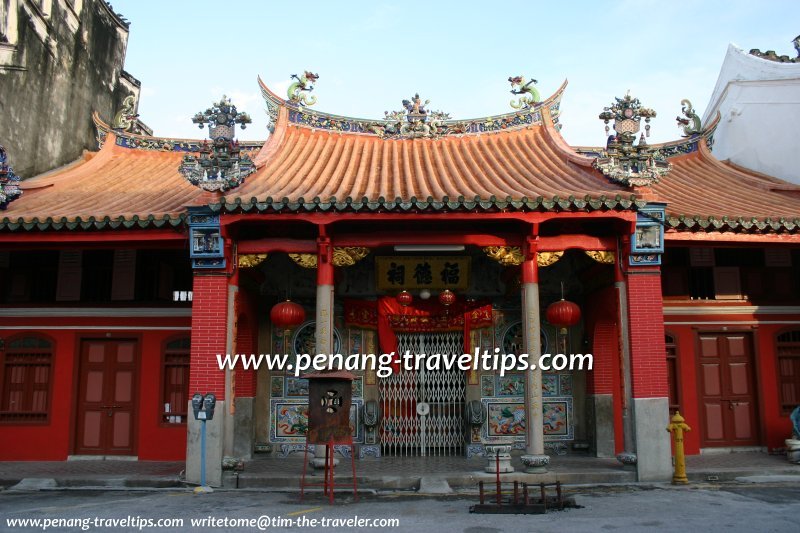 The Cantonese Tua Pek Kong Temple, George Town (20 March 2004)
Cantonese Tua Pek Kong Temple (GPS: 5.41841, 100.34007), also called Thai Pak Koong Temple, is a Taoist temple withing the George Town UNESCO World Heritage Site. It won the 2021 UNESCO Asia Pacific Awards for Cultural Heritage Conservation.
The Cantonese Tua Pek Kong Temple is located at 32, 32A & 34 King Street, sandwiched between the Heong San Hoay Kuan and the Nin Yong Temple, is what gives King Street its Chinese name, Kuin-Tang Tua Pek Kong Kay, meaning Cantonese Tua Pek Kong Temple Street.
Built in 1810, it is believed to be the second oldest Chinese temple in George Town (after the Kuan Im Teng Temple).
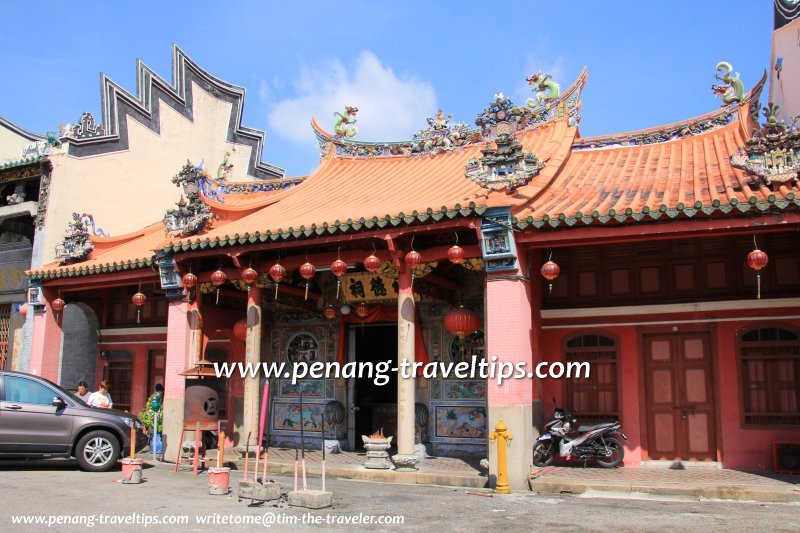 Cantonese Tua Pek Kong Temple, King Street, George Town (15 September 2012)
Tua Pek Kong, in the Penang context, is a deified personification of Tudigong. He is said to be a person of Hakka descent by the name of Zhang Li. Zhang Li arrived in the Malay peninsula in the mid 18th century. Enroute to Sumatra, his boat was caught in a storm that brought him to Penang. He landed there in the mid 18th century, a good 40 years before Francis Light founded the British settlement at George Town.
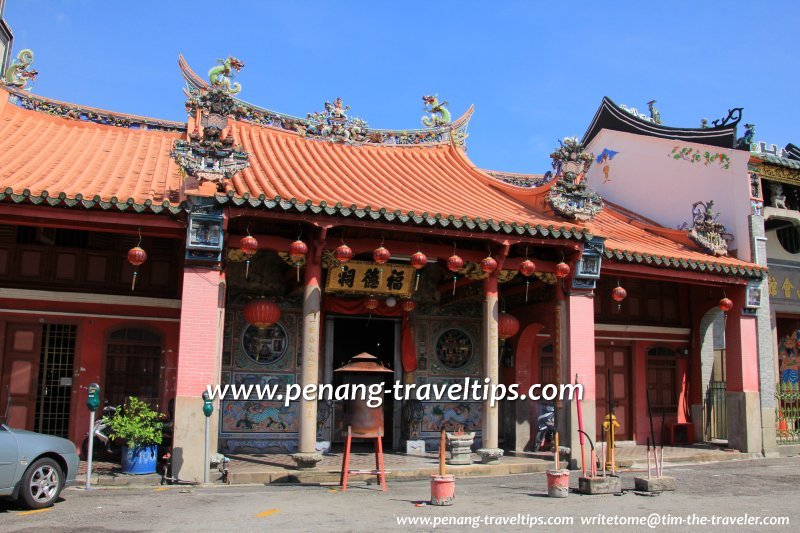 Another view of the Cantonese Tua Pek Kong Temple (15 September 2012)
Fifty years after the death of Zhang Li, the local Chinese in the Malay peninsula began the worship of him as Tua Pek Kong, meaning Great Grand Uncle, the god of prosperity. The Chinese believe that the worship of Tua Pek Kong help them in accumulating wealth and this ensures that shrines to Tua Pek Kong were constructed throughout West Malaysia, Singapore and East Malaysia. These shrines today become the Tua Pek Kong Temples. Accumulating wealth is a jealously guarded community endeavor. Hence the Hokkien and the Hakkas were split in their worship of this deity.
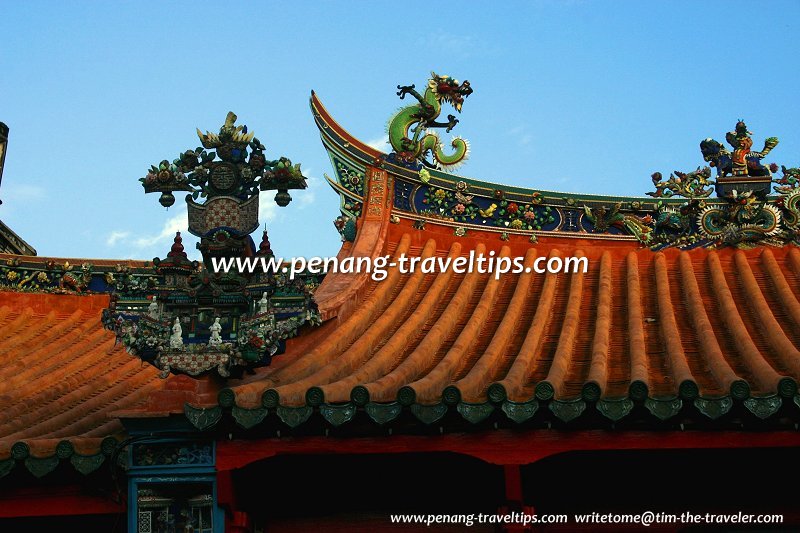 Roof features of the Cantonese Tua Pek Kong Temple (20 March 2004)
The Tua Pek Kong Temple of King Street is run by the Cantonese and Hakka community, while the Hokkiens have their own Tua Pek Kong Temple at the Hock Teik Cheng Sin in Armenian Street. In the olden days, both the Cantonese and the Hokkiens held annual processions to the Tanjong Tokong Tua Pek Kong Temple, regarded as the mother temple of all Tua Pek Kong temples in the region.
The Cantonese Tua Pek Kong Temple of King Street was built by the Hakka and Cantonese communities to ensure that the communities have a place to worship the god of prosperity. The building was constructed somewhere in the middle of the 18th century, with renovations done around 1909. Rather than conforming to the Cantonese style of temple architecture, as seen in the adjacent Nin Yong Temple next door, the Cantonese Tua Pek Kong Temple follows a Hokkien style temple architecture.
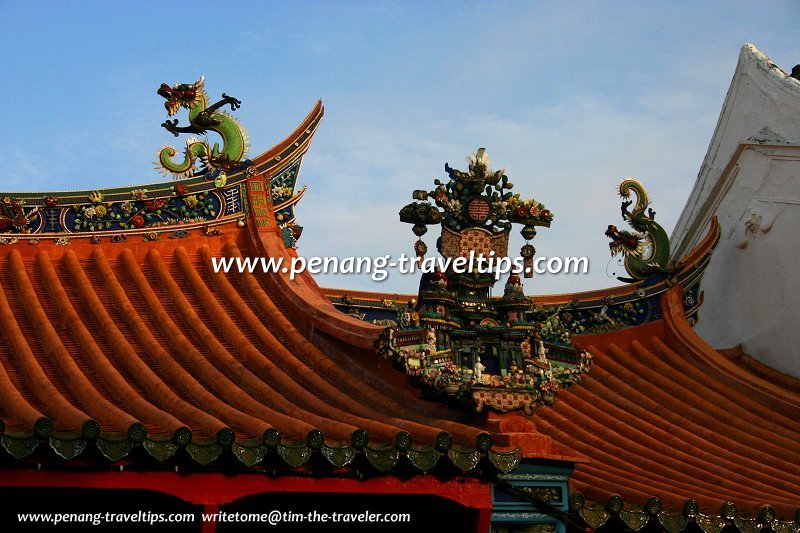 Chien Nien ornamentation of the Cantonese Tua Pek Kong Temple (20 March 2004)
What to see
Admire the roof ornamentation and sloping roof rafters. Chien Nien broken pottery ornamentation is used in the roof decoration, which sees dragons and tiny figurines. The red facade, divided into three bays, with ornate windows in the middle bay, is particularly attractive. On either side of the temple are side bays with act as living quarters, with decidedly simpler design.How to get there
Using Weld Quay Ferry & Bus Terminal as a point of reference, cross Pengkalan Weld and then turn right. Walk along Pengkalan Weld until you reach Gat Lebuh Gereja. Turn left. Walk along Gat Lebuh Gereja, past the Beach Street junction, onwards through Lebuh Gereja, until you reach Lebuh King. Turn left and you will find the Cantonese Tua Pek Kong Temple on the right side of the road, after the Heong San Hoay Kuan.Cantonese Tua Pek Kong Temple is  on the Map of Lebuh King, Penang
List of Tua Pek Kong Temples in Penang, Chinese Temples in Penang and Chinese Temples in Malaysia
 Buy, rent or sell properties in Penang
Do you have a property for sale or to rent out? Are you looking to buy or rent a property? Get in touch with me. WhatsApp me (Timothy Tye) at 012 429 9844, and I will assign one of my property agents to serve you. I will choose the agent for you, according to your property needs. So when you message me, provide me some details of what you need, whether to sell, to buy, to rent or to rent out, and what type of property, is it condo, apartment, house, shop, office or land.Adakah anda mempunyai hartanah untuk dijual atau disewakan? Adakah anda ingin membeli atau menyewa hartanah? Hubungi saya. WhatsApp saya (Timothy Tye) di 012 429 9844, dan saya akan menugaskan salah seorang ejen hartanah saya untuk berkhidmat kepada anda. Saya akan pilih ejen untuk anda, mengikut keperluan hartanah anda. Oleh itu, apabila anda menghantar mesej kepada saya, berikan saya beberapa butiran tentang apa yang anda perlukan, sama ada untuk menjual, untuk membeli, untuk disewakan atau untuk disewakan, dan jenis hartanah apakah itu kondo, pangsapuri, rumah, kedai, pejabat atau tanah.
您有待出售或出租的房产吗? 您想购买或租赁房产吗? 与我联系。 WhatsApp 我 (Timothy Tye) 012 429 9844,我将指派一名房地产经纪人为您服务。 我会根据您的房产需求,为您选择代理。 因此,当您给我发消息时,请向我提供一些您需要的详细信息,无论是出售、购买、出租还是出租,以及房产类型,是公寓、公寓、房屋、商店、办公室还是土地。
New Properties in Penang
Looking to buy property in Penang? Get the e-brochures right here without having to visit or contact individual developers.- Anggun Residences E-Brochure, Batu Kawan
- Aston Acacia E-Brochure, Bukit Mertajam
- Beacon Executive Suites E-Brochure, George Town
- Beverly Heights @ Bukit Gambir E-Brochure, Gelugor
- BM Highland E-Brochure, Bukit Mertajam
- Cypress Villa E-Brochure, Sungai Ara
- D'Zone Condominium E-Brochure, Teluk Kumbar
- Elements Garden E-Brochure, Butterworth
- Ferringhi Residence 2 E-Brochure, Batu Ferringhi
- GEM Residences E-Brochure, Prai
- Golden Triangle 2 E-Brochure, Sungai Ara/Relau
- Grace Residence E-Brochure, Jelutong
- Granito @ Permai E-Brochure, Tanjong Bungah
- Green City Residence E-Brochure, Jelutong
- Havana Beach Residences E-Brochure, Bayan Lepas
- Imperial Residences E-Brochure, Sungai Ara/Relau
- Imperial Grande E-Brochure, Sungai Ara/Relau
- Lucerne Residence E-Brochure, Bayan Lepas
- Mezzo @ The Light City E-Brochure, Gelugor
- Middleton E-Brochure, Gelugor
- Orchard Villa 3 E-Brochure, Simpang Ampat
- Primero Heights E-Brochure, Permatang Pauh
- Queens Waterfront Q2 E-Brochure, Bayan Lepas
- Royale Heights @ Tambun Royale City E-Brochure, Simpang Ampat
- Royale Infinity @ Tambun Royale City E-Brochure, Simpang Ampat
- Rubica @ Harbour Place E-Brochure, Butterworth
- Sensasi Commercial Suites E-Brochure, Batu Kawan
- Setia Sky Ville E-Brochure, Jelutong
- Setia Sky Vista E-Brochure, Sungai Ara/Relau
- Setia V Residence E-Brochure, Gurney Drive
- Sinaran Residence E-Brochure, Batu Kawan
- Sky @ TriPark E-Brochure, Bukit Mertajam
- Skyridge Garden E-Brochure, Tanjong Tokong
- Starhill Luxury Residences E-Brochure, Gelugor
- Straits Residences E-Brochure, Tanjong Tokong
- Taman Nuri Emas E-Brochure, Nibong Tebal
- The Light Collection IV E-Brochure, Gelugor
- The Loft @ Southbay E-Brochure, Batu Maung
- The Terraces Condominium E-Brochure, Bukit Jambul
- Trehaus Condo Villas E-Brochure, Bukit Jambul
- Triuni Residences E-Brochure, Batu Uban
- Urban Suites E-Brochure, Tanjong Tokong
- Valencia Residence E-Brochure, Bayan Lepas
- Vertu Resort E-Brochure, Batu Kawan
- Vivo Executive Apartment E-Brochure, Batu Kawan
- Viluxe E-Brochure, Batu Kawan
- Waterside Residence E-Brochure, Gelugor
Latest updates on Penang Travel Tips
Discover with Timothy YouTube Channel
PG Food Channel
Learn Penang Hokkien YouTube Channel
SojiMart Videos
Share your travels and/or ask a travel-related question
Join the Penang Travel Tips Facebook Group to share photos, tips and anything related to your travels, or ask travel-related questions.
 Map of Roads in Penang
Looking for information on Penang? Use this Map of Roads in Penang to zoom in on information about Penang, brought to you road by road. Discover with Timothy
Let me take you to explore and discover Penang through my series of walking tours on YouTube. You may use these videos as your virtual tour guide. At the beginning of each video, I provide the starting point coordinates which you may key into your GPS, Google Maps or Waze, to be navigated to where I start the walk, and use the video as your virtual tour guide.Disclaimer
Please use the information on this page as guidance only. The author endeavours to update the information on this page from time to time, but regrets any inaccuracies if there be any.Latest from Discover with Timothy: Gurney Bay - what to see and do there
About this website

Hello and thanks for reading this page. My name is Timothy and my hobby is in describing places so that I can share the information with the general public. My website has become the go to site for a lot of people including students, teachers, journalists, etc. whenever they seek information on places, particularly those in Malaysia and Singapore. I have been doing this since 5 January 2003, for over twenty years already. You can read about me at Discover Timothy. By now I have compiled information on thousands of places, mostly in Peninsular Malaysia and Singapore, and I continue to add more almost every day. My goal is to describe every street in every town in Malaysia and Singapore.
Robbie's Roadmap
- Episode 1: Robbie's Journey to Financial Freedom
- Episode 2: Lost in America
- Episode 3: The Value of Money
- Episode 4: The Mentor
- Episode 5: The Thing that Makes Money
- Episode 6: The walk with a Billionaire
- Episode 7: The Financial Freedom Awakening
- Episode 8: Meet Mr Washington
- Episode 9: The Pizzeria Incident
Copyright © 2003-2024 Timothy Tye. All Rights Reserved.