

Pulau Kendi
 Go Back - Latest PENANG Sights/Streets/New Properties > Malaysia > World | Hokkien : Lessons : Dictionary | YouTube | Facebook | About Me : Contact Me
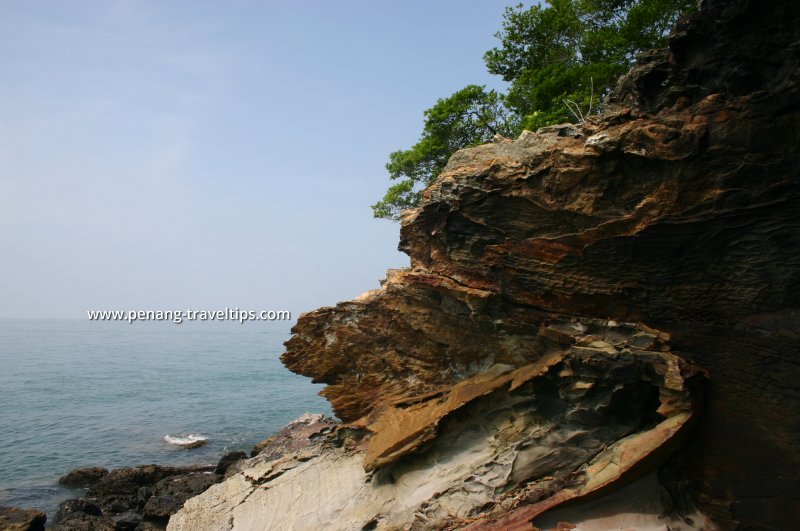 Cliff side at Pulau Kendi (28 March 2004)
Pulau Kendi is a small island on the southwestern tip of Penang island, off Gertak Sanggul. It is the farthest of the few islets around Penang Island. Due to its distance from Penang Island, Pulau Kendi has managed to keep itself relatively pristine.
Pulau Kendi is one of the few places left where you can still see the rocks on the sea bed. It's It is also the only place in Penang where you can still swim the sea without fear of jellyfish. And, it is the only place in Penang where you can go snorkelling and view live corals. The Pulau Kendi coral reef is health and alive, but requires all our care to keep it protected, so that it can be enjoyed by all.
 Pulau Kendi, as seen from the sea (28 March 2004)
The name of Pulau Kendi comes from the word "kendi" which means flask in Malay. As you approach the island from Gertak Sanggul, you will begin to understand why it is given such a name. The island resembles a gargantuan flask lying on its size in the sea. For the same reason Pulau Kendi is known in Hokkien as Hor3 Lor3 Su33
 , or Gourd Island. It has long been known to fishermen as well as anglers as the drop-off point before the open sea, Pulau Kendi was left largely unnoticed until recently, when reports appeared in the media that there are plans of turning it into a tourist destination.
Fearful that wanton development will wash onto its rocky shores, I made several visits to Pulau Kendi. We went there ascertain its tourism potential and to recommend how the beauty of Pulau Kendi can best be appreciated and tapped.
Pulau Kendi in Penang Hokkien
This short video is created for the benefit of learners of Penang Hokkien. Listen to the narrative on Pulau Kendi in Penang Hokkien and follow the words in the TJ System of romanization. English translation is also provided.Go to Learn Penang Hokkien to learn the language and join the Learn Penang Hokkien Facebook Group.
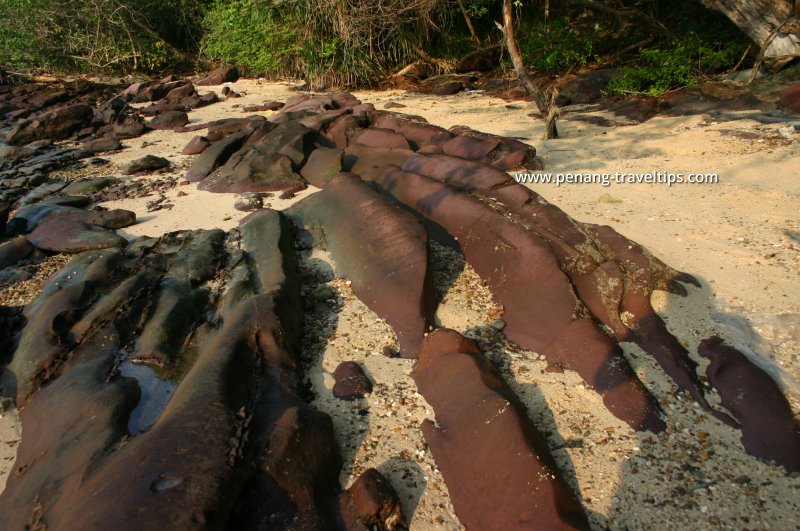
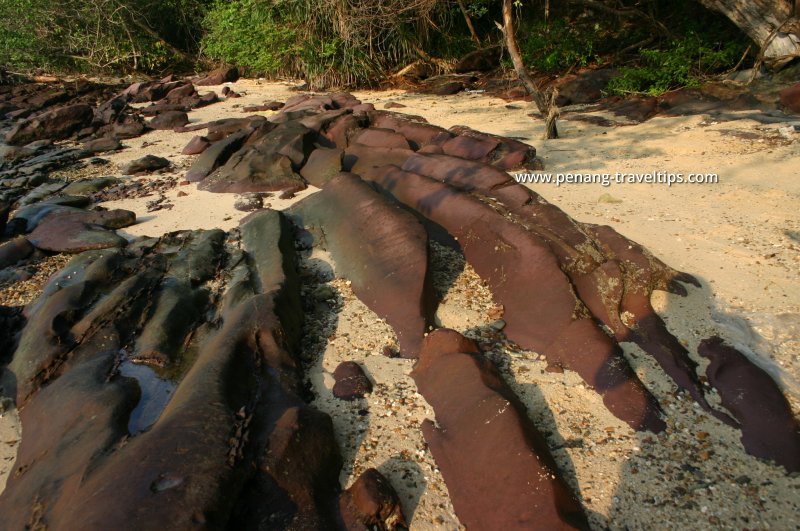 Rock formation, Pulau Kendi (28 March 2004)
We found in Pulau Kendi a scabrous island surrounded by an emerald green sea. What attracted me most about Pulau Kendi are its natural rock formations. These can be found along the southern coastline of the island, and they come in a glorious selection of shapes, hues and sizes.
Relentlessly battered by the raging sea, they were both formed as well as eroded by the elements. These rock formations are slippery as polished marble, and as sharp as razor, and they run the gamut from magma to sedimentary rocks to hard granite. Some are pockmarked like scars from acne, others like petrified corals, toad stools, you name it.
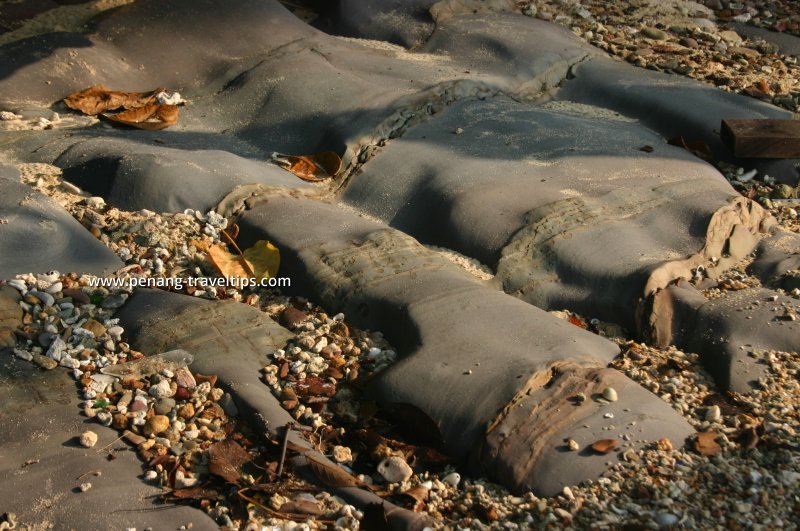 Rock formation, Pulau Kendi (28 March 2004)
The hills of Pulau Kendi are steep and densely forested, making exploration a challenging experience. The only sandy stretch of beach was no more than 100 feet in length. That was where we landed. From there, we cut our way up the hill, crossed to the other side. There was a team of anglers perched precariously on the jagged outcrops between the water line.
On the steepest slope at the most hidden crevice, we found a cliffside adorned with scores of tiny idols. There was Kuan Yin, the goddess of mercy, as well as a plethora of deities, statues no taller than one foot. They guard, they watch over the open sea, while the waves blast on the rocks below. We could only speculate who have placed them there.
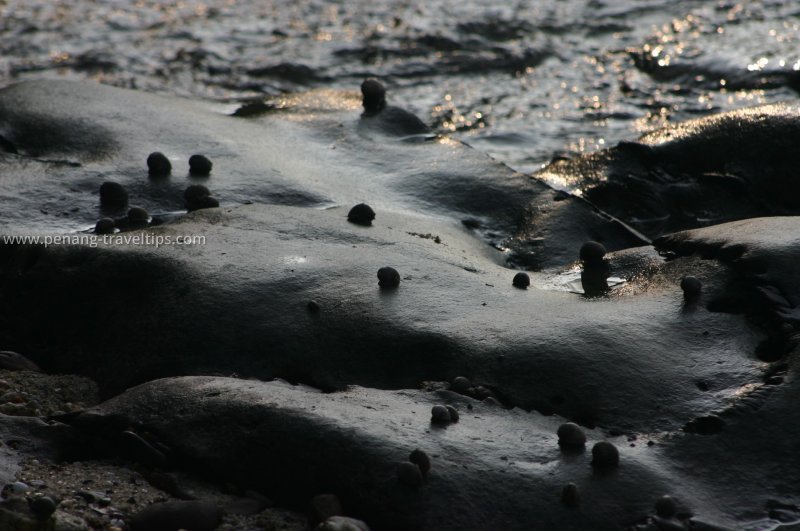 Snails on the rock in Pulau Kendi (28 March 2004)
Although the island was uninhabited, we found signs of civilization in abundance, all over the place, in the form on inorganic refuse. The entire beach front was littered with plastic bottles, wrappers, tyre tubes.
It appears that the island is being used as a convenient dumping ground. We were disheartened by this disrespect for nature and the environment, and that the people of Malaysia in general, and Penang in particular, could not lift themselves above the filthy habit of littering the land. We must say that this is the work of a small minority, but the result affects the well-being of the entire majority.
If Pulau Kendi is to be recognised as a tourist destination, the first and most important item on the agenda should be a clean-up of the island. All inorganic refuse must be cleared. Footpaths can be cleared to traverse the island, taking visitors to specific look-out points. In the seas, fish fry, and planktons should be released to improve on the variety as well as quantity of fishlife. The corals should be breed. Angling should be controlled and licensed.
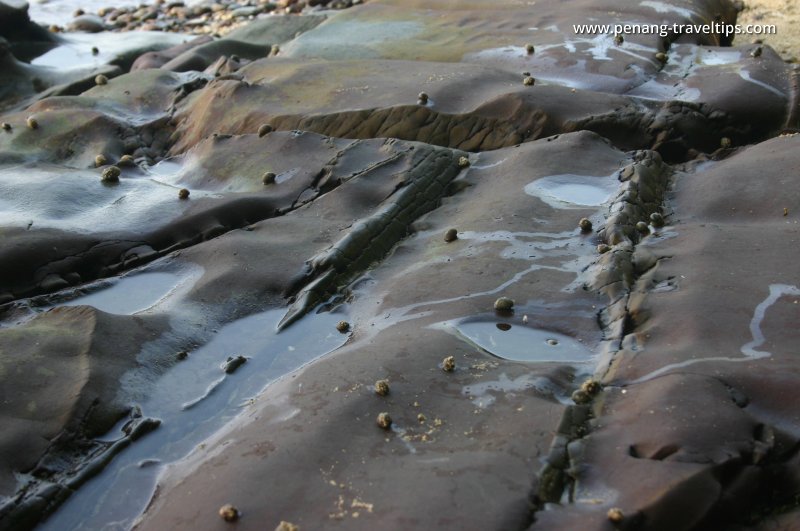 Pulau Kendi's rock pools (28 March 2004)
Commercial fishing should be barred from approaching anywhere closer than three hundred metres from the island. Only environmentally conscious organisations should be allowed to bring visitors to Pulau Kendi, and a fee should be charged which will be used for the upkeep and maintenance of the island. I further recommend that the caretaker, in the form of a forest ranger, should be authorised to issue summons to whoever is caught littering the island.
There should be no construction of any structures on the island, except for a caretaker's abode. Certainly no chalets here please. There should be no cement brought, as this will pollute the sea. No pier should be built. The only access should be by boat. It should remain a place where the environmentally conscious can come to appreciate the nearness to nature, in a pristine surrounding.
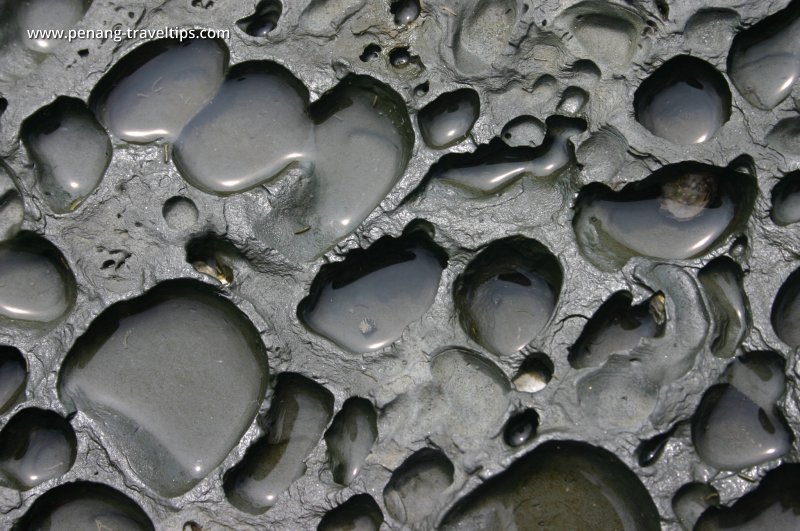 Pulau Kendi's Moonscape (28 March 2004)
This is the most pristine part of Penang, the only pristine one remaining. If you ever consider visiting it, we urge you to keep it clean. It will be worth your effort.
Nearby Sights
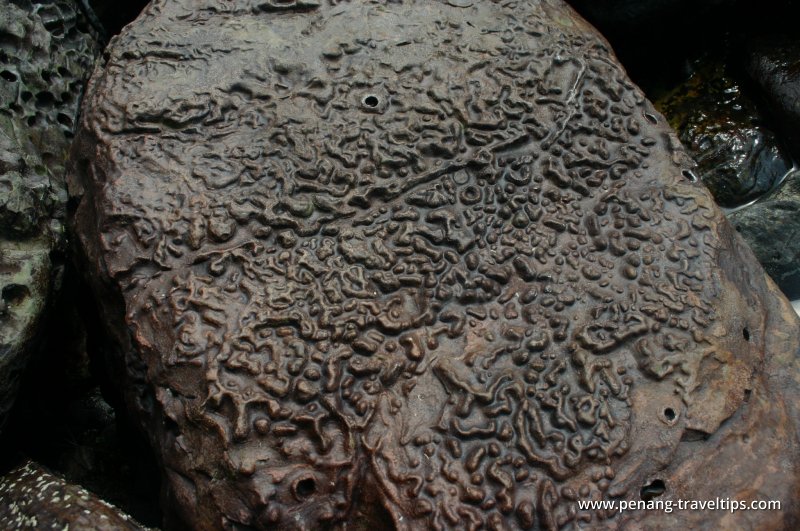 Nature's writing, Pulau Kendi (28 March 2004)
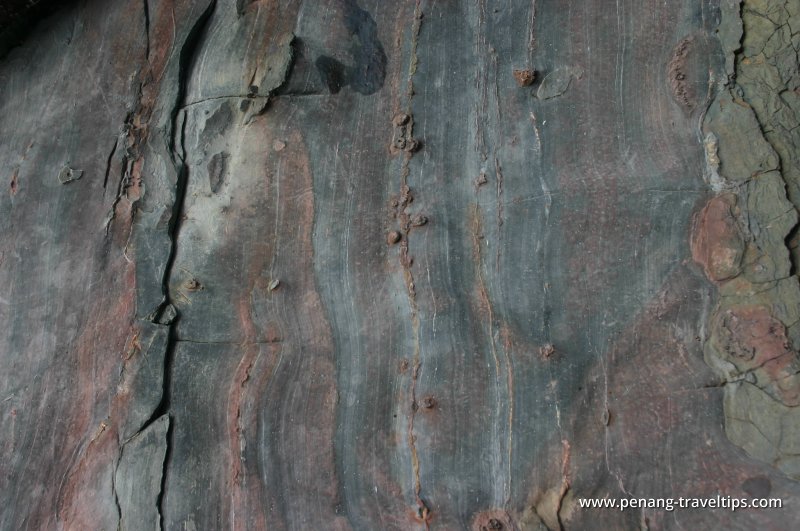 Pulau Kendi's rock of many colors (28 March 2004)
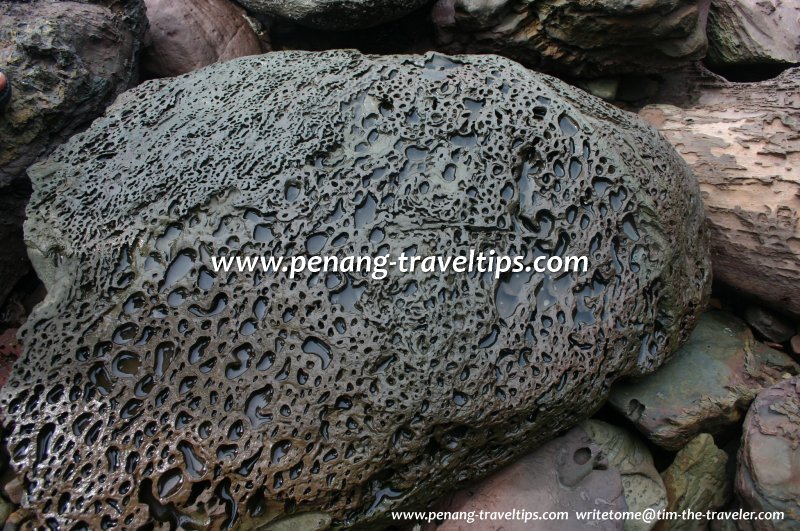 Brain coral, Pulau Kendi style (28 March 2004)
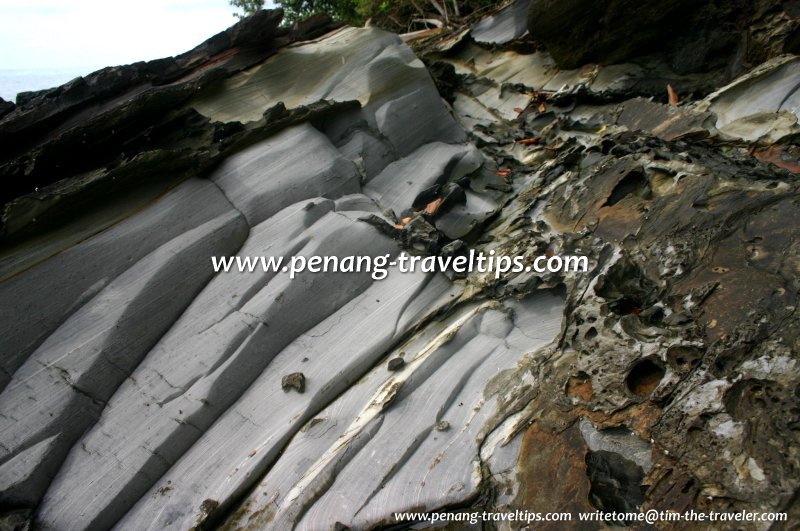 Nature's pillars at Pulau Kendi (28 March 2004)
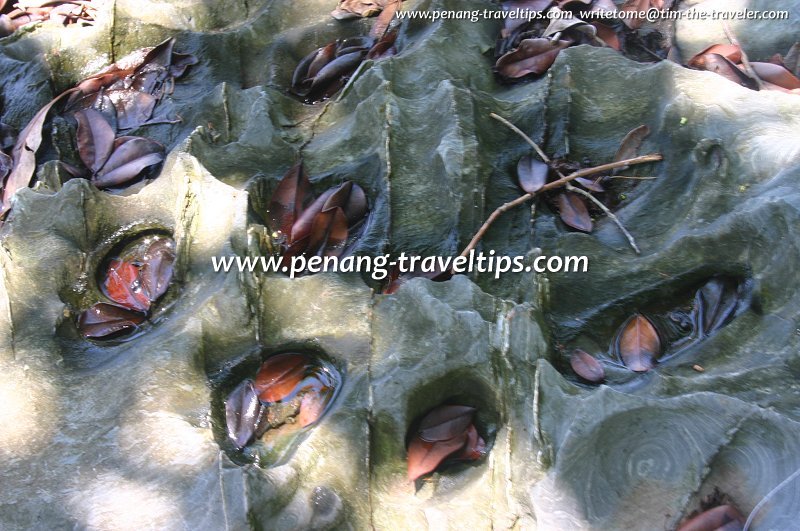 Pockets of dry leaves (28 March 2004)
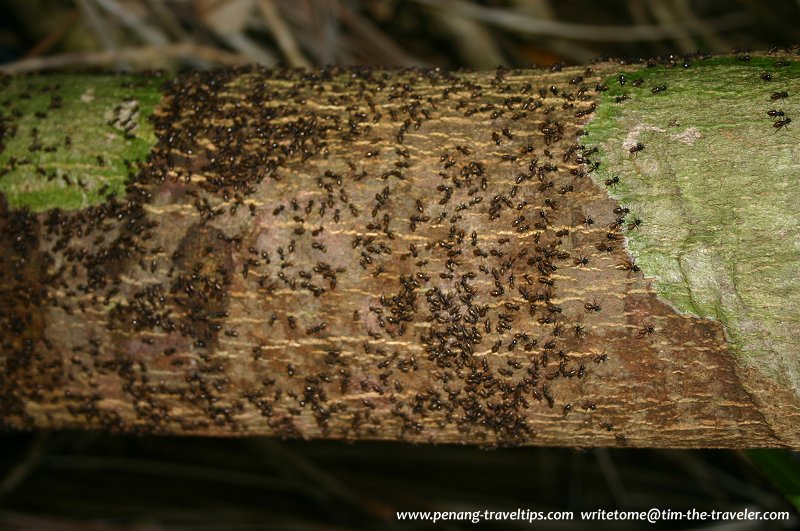 Ants on a trunk at Pulau Kendi (28 March 2004)
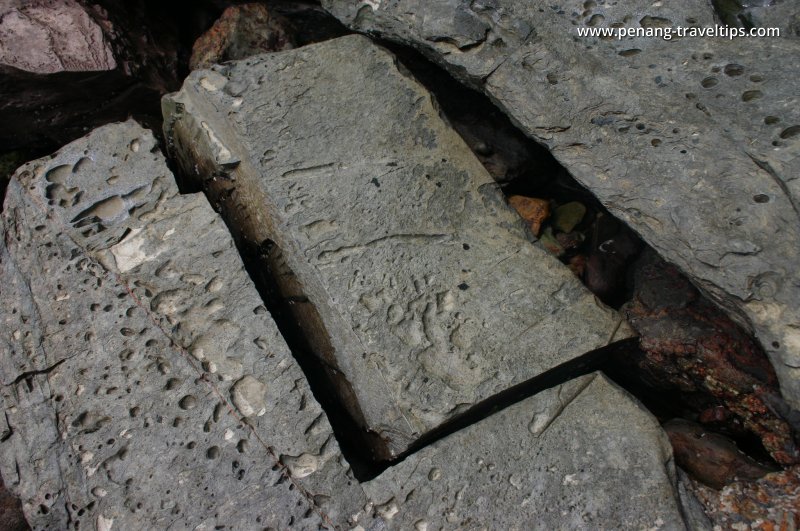 Stone blocks at Pulau Kendi (28 March 2004)
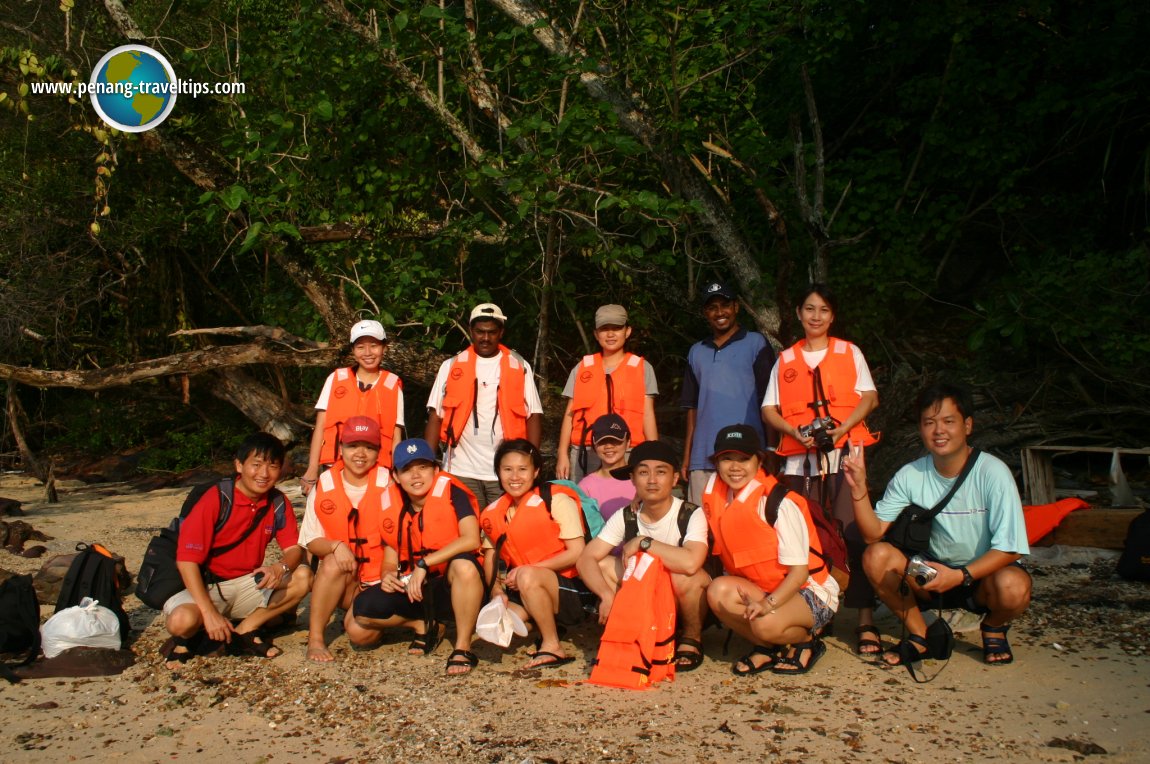 AsiaExplorers trip to Pulau Kendi (28 March 2004)
Getting there
To get to Pulau Kendi, approach the fishermen at Teluk Kumbar or Gertak Sanggul and arrange with them to take you there. They will leave you on Pulau Kendi, and return to fetch you later in the day. Make sure you have your mobile phone with you to call them. Check that your phone as signal, and adequate battery, so as not to be marooned on the island.Location of Pulau Kendi on the map
List of Islands in Penang and Islands in Malaysia
 Buy, rent or sell properties in Penang
Do you have a property for sale or to rent out? Are you looking to buy or rent a property? Get in touch with me. WhatsApp me (Timothy Tye) at 012 429 9844, and I will assign one of my property agents to serve you. I will choose the agent for you, according to your property needs. So when you message me, provide me some details of what you need, whether to sell, to buy, to rent or to rent out, and what type of property, is it condo, apartment, house, shop, office or land.Adakah anda mempunyai hartanah untuk dijual atau disewakan? Adakah anda ingin membeli atau menyewa hartanah? Hubungi saya. WhatsApp saya (Timothy Tye) di 012 429 9844, dan saya akan menugaskan salah seorang ejen hartanah saya untuk berkhidmat kepada anda. Saya akan pilih ejen untuk anda, mengikut keperluan hartanah anda. Oleh itu, apabila anda menghantar mesej kepada saya, berikan saya beberapa butiran tentang apa yang anda perlukan, sama ada untuk menjual, untuk membeli, untuk disewakan atau untuk disewakan, dan jenis hartanah apakah itu kondo, pangsapuri, rumah, kedai, pejabat atau tanah.
您有待出售或出租的房产吗? 您想购买或租赁房产吗? 与我联系。 WhatsApp 我 (Timothy Tye) 012 429 9844,我将指派一名房地产经纪人为您服务。 我会根据您的房产需求,为您选择代理。 因此,当您给我发消息时,请向我提供一些您需要的详细信息,无论是出售、购买、出租还是出租,以及房产类型,是公寓、公寓、房屋、商店、办公室还是土地。
New Properties in Penang
Looking to buy property in Penang? Get the e-brochures right here without having to visit or contact individual developers.- Anggun Residences E-Brochure, Batu Kawan
- Aston Acacia E-Brochure, Bukit Mertajam
- Beacon Executive Suites E-Brochure, George Town
- Beverly Heights @ Bukit Gambir E-Brochure, Gelugor
- BM Highland E-Brochure, Bukit Mertajam
- Cypress Villa E-Brochure, Sungai Ara
- D'Zone Condominium E-Brochure, Teluk Kumbar
- Elements Garden E-Brochure, Butterworth
- Ferringhi Residence 2 E-Brochure, Batu Ferringhi
- GEM Residences E-Brochure, Prai
- Golden Triangle 2 E-Brochure, Sungai Ara/Relau
- Grace Residence E-Brochure, Jelutong
- Granito @ Permai E-Brochure, Tanjong Bungah
- Green City Residence E-Brochure, Jelutong
- Havana Beach Residences E-Brochure, Bayan Lepas
- Imperial Residences E-Brochure, Sungai Ara/Relau
- Imperial Grande E-Brochure, Sungai Ara/Relau
- Lucerne Residence E-Brochure, Bayan Lepas
- Mezzo @ The Light City E-Brochure, Gelugor
- Middleton E-Brochure, Gelugor
- Orchard Villa 3 E-Brochure, Simpang Ampat
- Primero Heights E-Brochure, Permatang Pauh
- Queens Waterfront Q2 E-Brochure, Bayan Lepas
- Royale Heights @ Tambun Royale City E-Brochure, Simpang Ampat
- Royale Infinity @ Tambun Royale City E-Brochure, Simpang Ampat
- Rubica @ Harbour Place E-Brochure, Butterworth
- Sensasi Commercial Suites E-Brochure, Batu Kawan
- Setia Sky Ville E-Brochure, Jelutong
- Setia Sky Vista E-Brochure, Sungai Ara/Relau
- Setia V Residence E-Brochure, Gurney Drive
- Sinaran Residence E-Brochure, Batu Kawan
- Sky @ TriPark E-Brochure, Bukit Mertajam
- Skyridge Garden E-Brochure, Tanjong Tokong
- Starhill Luxury Residences E-Brochure, Gelugor
- Straits Residences E-Brochure, Tanjong Tokong
- Taman Nuri Emas E-Brochure, Nibong Tebal
- The Light Collection IV E-Brochure, Gelugor
- The Loft @ Southbay E-Brochure, Batu Maung
- The Terraces Condominium E-Brochure, Bukit Jambul
- Trehaus Condo Villas E-Brochure, Bukit Jambul
- Triuni Residences E-Brochure, Batu Uban
- Urban Suites E-Brochure, Tanjong Tokong
- Valencia Residence E-Brochure, Bayan Lepas
- Vertu Resort E-Brochure, Batu Kawan
- Vivo Executive Apartment E-Brochure, Batu Kawan
- Viluxe E-Brochure, Batu Kawan
- Waterside Residence E-Brochure, Gelugor
Latest updates on Penang Travel Tips
Discover with Timothy YouTube Channel
PG Food Channel
Learn Penang Hokkien YouTube Channel
SojiMart Videos
Share your travels and/or ask a travel-related question
Join the Penang Travel Tips Facebook Group to share photos, tips and anything related to your travels, or ask travel-related questions.
 Map of Roads in Penang
Looking for information on Penang? Use this Map of Roads in Penang to zoom in on information about Penang, brought to you road by road. Discover with Timothy
Let me take you to explore and discover Penang through my series of walking tours on YouTube. You may use these videos as your virtual tour guide. At the beginning of each video, I provide the starting point coordinates which you may key into your GPS, Google Maps or Waze, to be navigated to where I start the walk, and use the video as your virtual tour guide.Disclaimer
Please use the information on this page as guidance only. The author endeavours to update the information on this page from time to time, but regrets any inaccuracies if there be any.Latest from Discover with Timothy: Gurney Bay - what to see and do there
About this website

Hello and thanks for reading this page. My name is Timothy and my hobby is in describing places so that I can share the information with the general public. My website has become the go to site for a lot of people including students, teachers, journalists, etc. whenever they seek information on places, particularly those in Malaysia and Singapore. I have been doing this since 5 January 2003, for over twenty years already. You can read about me at Discover Timothy. By now I have compiled information on thousands of places, mostly in Peninsular Malaysia and Singapore, and I continue to add more almost every day. My goal is to describe every street in every town in Malaysia and Singapore.
Robbie's Roadmap
- Episode 1: Robbie's Journey to Financial Freedom
- Episode 2: Lost in America
- Episode 3: The Value of Money
- Episode 4: The Mentor
- Episode 5: The Thing that Makes Money
- Episode 6: The walk with a Billionaire
- Episode 7: The Financial Freedom Awakening
- Episode 8: Meet Mr Washington
- Episode 9: The Pizzeria Incident
Copyright © 2003-2024 Timothy Tye. All Rights Reserved.