

Penang Botanic Gardens (Kebun Bunga)
 Go Back - Latest PENANG Sights/Streets/New Properties > Malaysia > World | Hokkien : Lessons : Dictionary | YouTube | Facebook | About Me : Contact Me
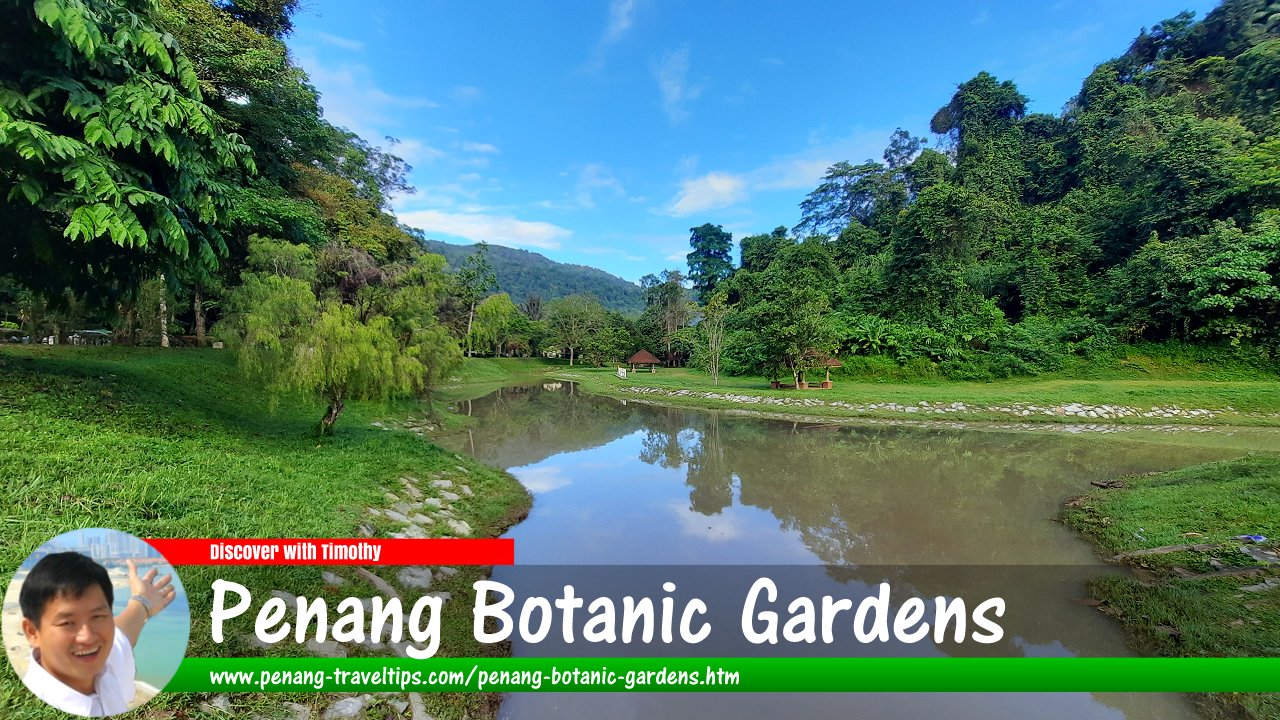 Penang Botanic Gardens (17 December 2022)
Penang Botanic Gardens (GPS: 5.43773, 100.2907), also written as Penang Botanical Gardens or Kebun Bunga, is the most important city park in Penang. It is located on Jalan Kebun Bunga, on the western edge of George Town and is open daily to the public. The gardens are one of the major local attractions in Penang, and can get very crowded especially during weekends.
How to reach the Penang Botanic Gardens
The Penang Botanic Gardens is served by Rapid Penang bus 10. You can also reach by taking the Penang Hop-On Hop-Off Tourist Bus.The Penang Botanic Gardens is  on the Map of Jalan Kebun Bunga, Penang
Visitor Information
Opening hours: 5:00am-8:00pmAdmission: free
Facilities: Parking lots are available outside the main entrance. This is not always sufficient, given that the Gardens is also a popular park for Penangites. Additional parking space is available beside the jeep track to Penang Hill, and along the road side up to Moon Gate.
Toilet: located near the entrance. Look for posted signboard
Souvenir shop: located near the entrance. It has a good stock of books related to botany. Other items sold include organic products, t-shirts and trinkets.
Exhibition: An international flower fest is held at the Penang Botanic Gardens every year.
Map of the Penang Botanic Gardens
 Sights in the Penang Botanic Gardens
- Bambusetum (GPS: 5.43716, 100.29229)
 Landscaped botanic garden showcasing various types of bamboo species.
 - Dataran Teratai (GPS: 5.43713, 100.29103)

Waterlily pond with Amazonian waterlilies. - Lily Pond (GPS: 5.44127, 100.29023)
 A serene pond on the northeast part of the garden.
 - Jeep Track (GPS: 5.43766, 100.29015) Tar road winding its way from the garden to Penang Hill
- Moon Gate (GPS: 5.43573, 100.29278)
 Preserved historic gate to a now demolished bungalow.
 - Penang Botanic Garden Hawker Complex (GPS: 5.43484, 100.29491)
- Penang Botanic Gardens Waterfall (GPS: 5.44038, 100.28248, off limits)
 The biggest waterfall on Penang Island, this large waterfall is located behind the Penang Botanic Gardens Reservoir.
 - Sunken Garden (GPS: 5.43731, 100.29189)
 Multi-tiered garden cascading down from the main road
Penang Orchid Show
The annual Penang Orchid Show is one of the highlights of the Penang Botanic Gardens. Here are some of the coverage of the show from different years.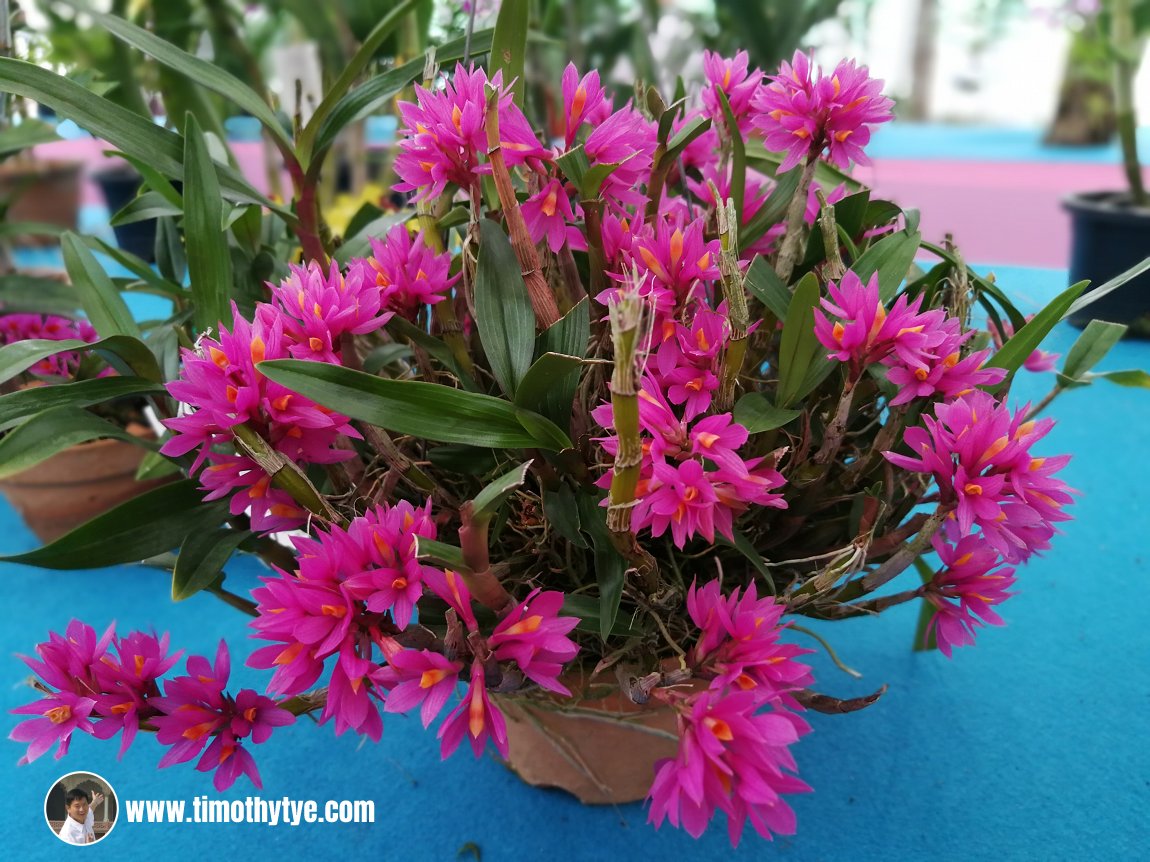
Amenities
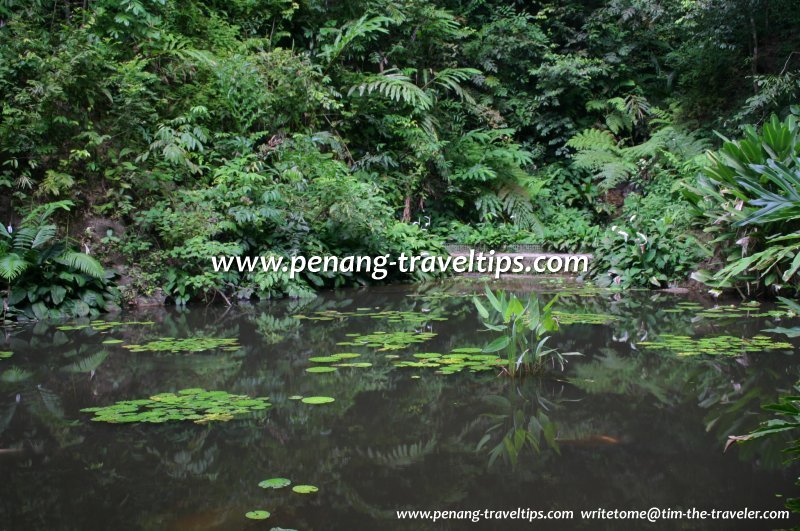 Penang Botanic Gardens Lily Pond(11 January 2005)
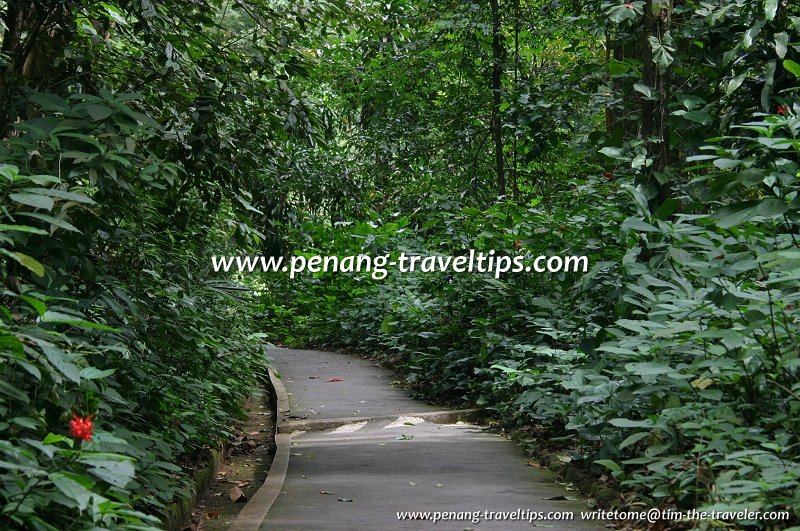 Forest path, Penang Botanic Gardens (11 January 2005)
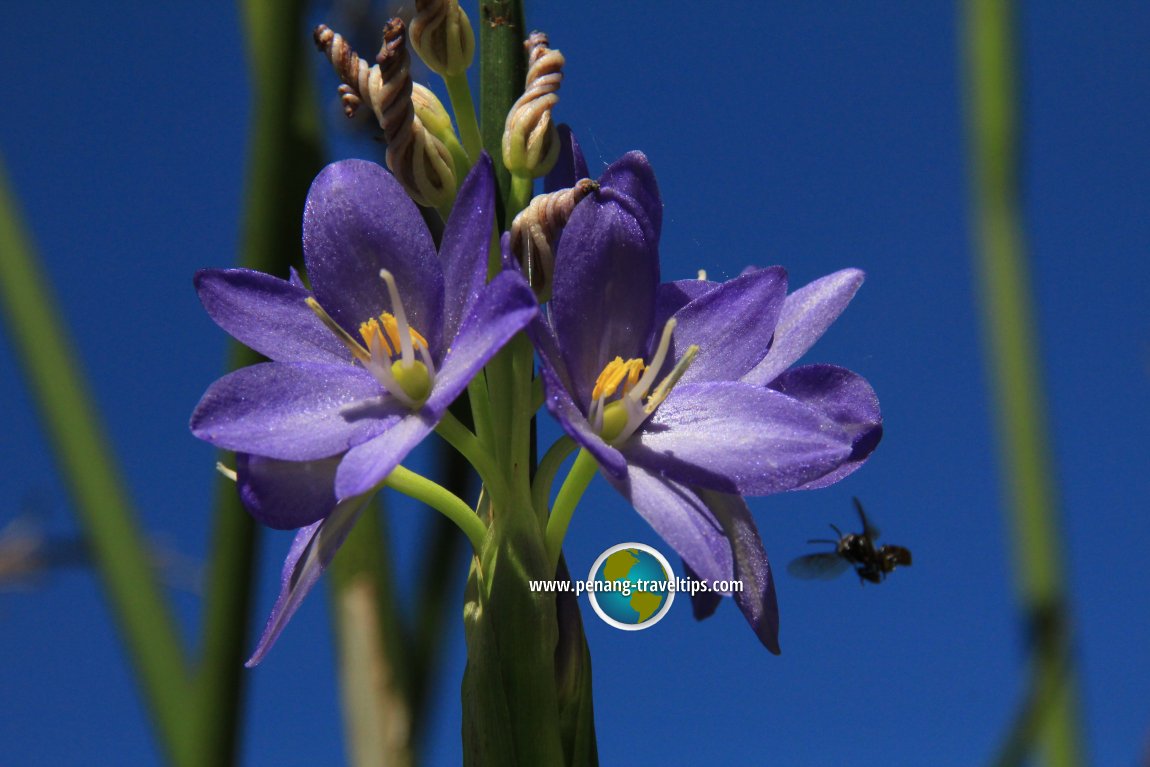 Flowers blooming at Dataran Teratai, Penang Botanic Gardens (3 December 2011)
History of the Penang Botanic Gardens
The Penang Botanic Gardens was founded in 1884 as an offshoot of the Singapore Botanic Gardens. Before that, the early British administrators had several false starts in establishing a botanic garden in Penang, beginning with one in 1796, which was sold off to a horticultural society, Penang Gardens. Next came another shortlived attempt managed by George Porter, a headmaster, and opened by Stamford Raffles in 1822. None of these earlier gardens survived long. It was only in 1884 that the Singapore Botanic Gardens, under Nathaniel Cantley, established a Penang Botanic Gardens, which survives in one form or another, till this day. In those early years, the director of the Singapore Botanic Gardens also act as the director of the Penang gardens.The objective of the founding was to safeguard the economic interest of the British colonial government. It was at an era when new plants were being discovered by colonials all over the world, and research conducted to exploit the potential of these new discoveries. The Penang Botanic Gardens therefore was established so that seedlings from different parts of the world can be planted and tested for commercial viabilities. English botanist Henry Ridley was already working in the Singapore Botanic Gardens and was soon instrumental in introducing rubber into Malaya.
In its early days, the Penang Botanic Gardens were not a place for recreational activities. Serious commercial experiments were conducted here to ascertain the viability of commercial crops and to devise improved planting methods. The spillover effect of all these scientific activities is that the Gardens became a storehouse of rare and exquisite plants, usually kept behind lock and key and away from the general public.
The site chosen was a valley to the west of George Town. A river runs through the valley. It comes down from a big waterfall and cascades down towards George Town in the form of Sungai Air Terjun. Due to this waterfall, the Gardens were often also called the Waterfall Gardens.
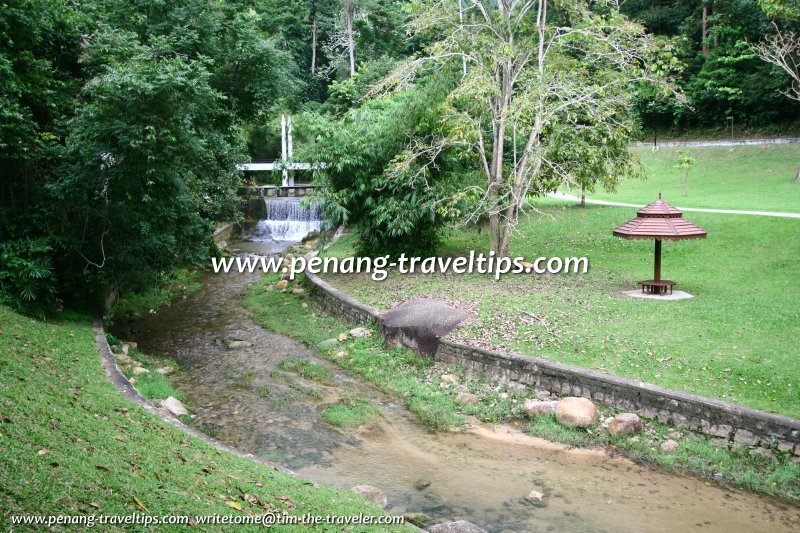 Stream flowing from the Penang Botanic Gardens Waterfall (23 June 2006)
In 1910, the Penang Botanic Gardens was threatened by a government initiative to turn the valley into a massive reservoir by damming Sungai Air Terjun. Fortunately for the Gardens, the plans were not carried out. However, its role has started to evolve. By the 1920's and 30's, it also took on the responsibility of beautifying George Town and the planting of roadside trees.
There were Hindu shrines all along the way from George Town to the Botanic Gardens. The main temple within the garden was relocated when the garden was expanded in the early 20th century. This temple, the Balathandayuthapani, is one of the main locations for the annual Thaipusam festival.
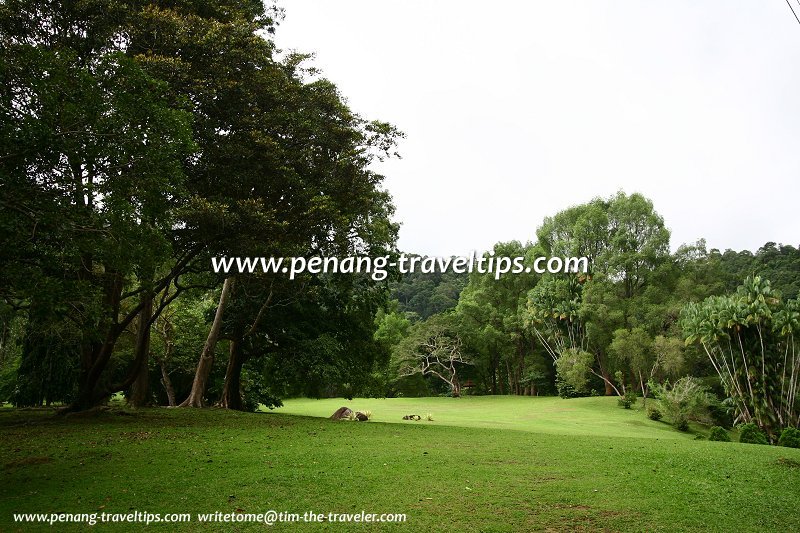 The lawn at the Penang Botanic Gardens (23 June 2006)
The Second World War set in motion changes to the Penang Botanic Gardens that was not to reverse thereafter. During the Japanese occupation, the Gardens suffered greatly; Assistant Curator-in-charge, J.C. Nauen, was sent to Kanchanaburi, Thailand, to work on the Death Railway, and he never came back alive. Meanwhile, the Gardens came under the running of Professor Watanabe, who did an extensive collection of botanic illustrations on the food and medicinal plants of the tropics. The ongoing war took a toll on the Gardens as lack of funds prevented proper management. The Japanese also built tunnels to store ammunition using forced labor. A collapse of these tunnels claimed many lives, leading to beliefs or legend that there may still be a store of Japanese treasure in or around the Lily Pond today.
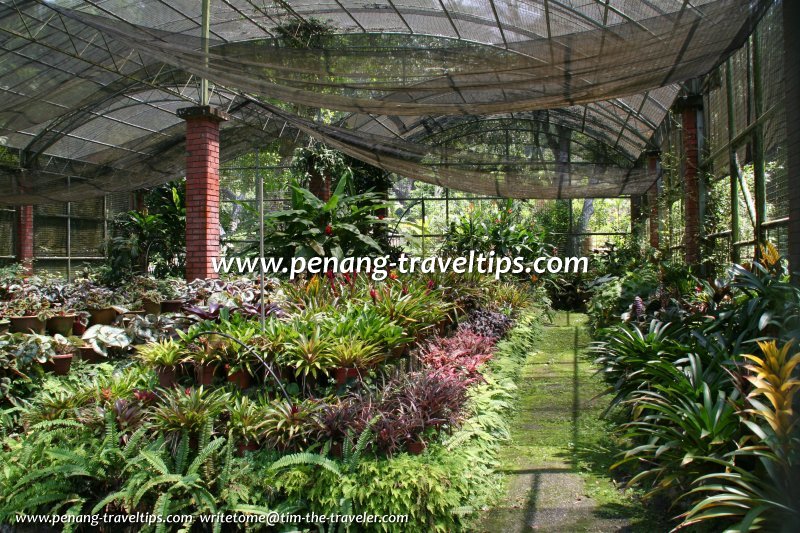 The Bromeliad and Begonia House at the Penang Botanic Gardens (30 June 2007)
After the war ended, the Penang Botanic Gardens was formally separated from the Singapore Botanic Gardens in terms of administration. In 1956 Mr Cheang Kok Choy was the first local appointed as Curator of the Penang Botanic Gardens, holding the post until his retirement in 1976.
Today the Penang Botanic Gardens is an arm of the Penang State Government, under the Penang Botanic Gardens Department (Pejabat Kebun Bunga). No longer tasked to be a lab for experimental crops, today its role is one of providing a safe and clean recreational environment for the general public.
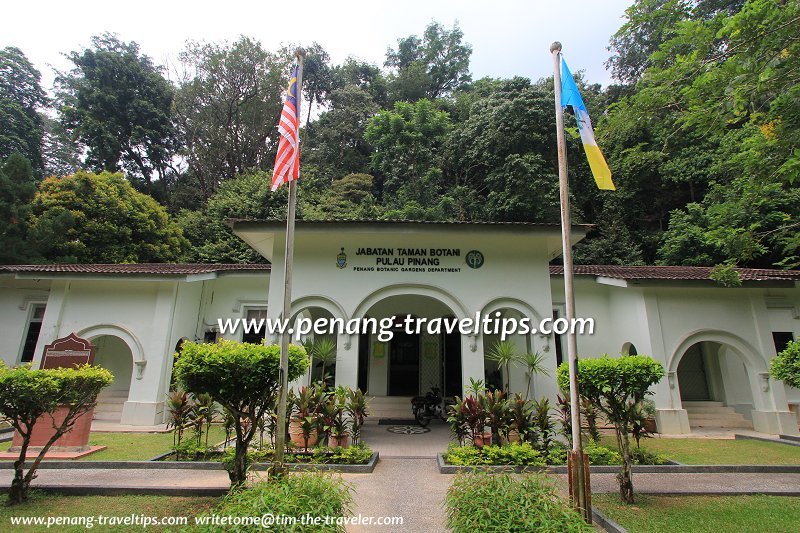 Penang Botanic Gardens Department (2 August 2011)
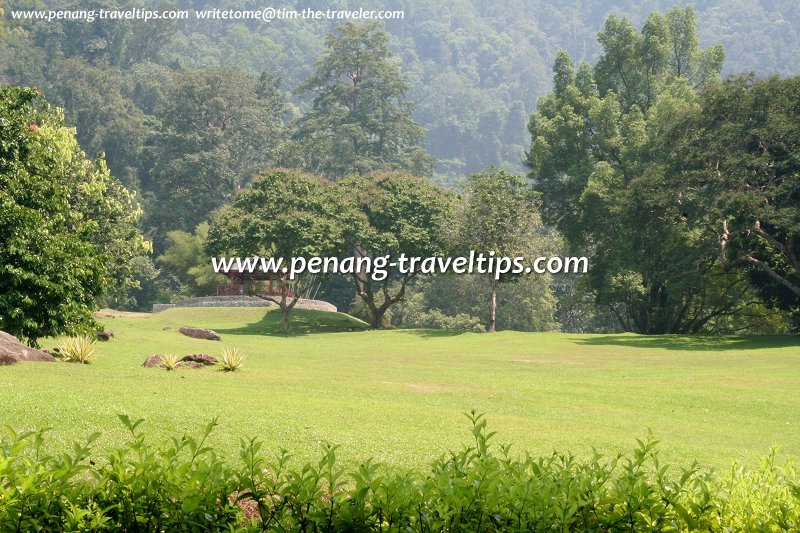 Scenery at the Penang Botanic Gardens (30 June 2007)
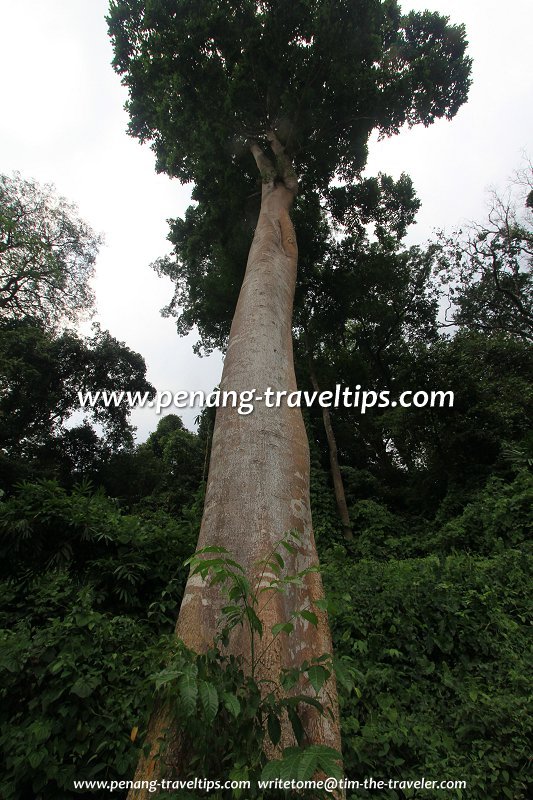 Ipoh Tree (Antiaris toxicaria), Penang Botanic Gardens (2 August 2011)
Updates on the Penang Botanic Gardens
14 December 2022Free Malaysia Today reports that Hartasuma Sdn Bhd has been selected to build the Penang Cable Car connecting the Penang Botanic Gardens to Penang Hill.
11 June, 2011
Dataran Teratai was officially opened at the Penang Botanic Gardens with its star attraction being the giant water lilies of the Amazon River basin.
3 June, 2011
The leptospirosis bacteria is detected in water samples taken in April from streams outside the Botanic Gardens. State health, welfare, caring society and environment committee chairman Phee Boon Poh advises the public to stay away from the water. The gardens chief controller Datuk Tengku Idaura has been informed.
3 June, 2011
The first 1Malaysia Parks and Gardens Carnival will be held at the Penang Botanic Gardens on 11-12 June, 2011. The Rapid Penang Bus 10 will offer free shuttle service from the Weld Quay Ferry & Bus Terminal and Komtar Bus Terminal to the gardens every 10 minutes.
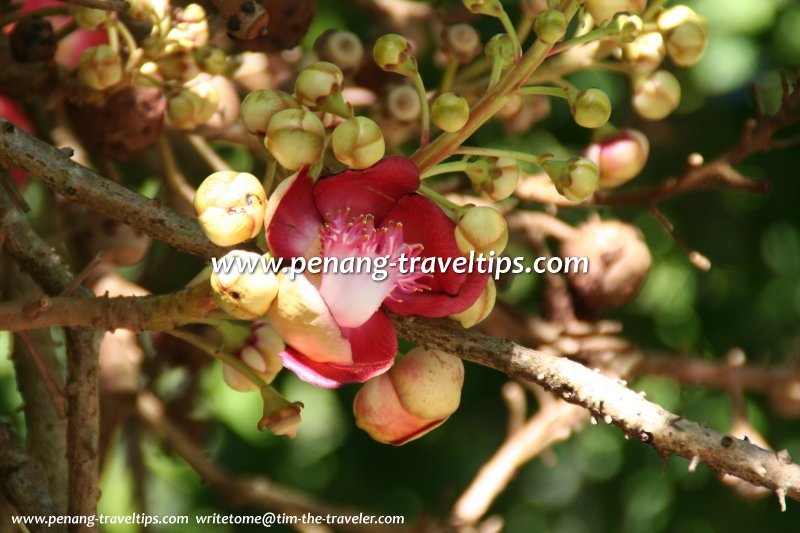 Flower of Couroupita guianensis, better known as the Cannon Ball tree (27 January 2008)
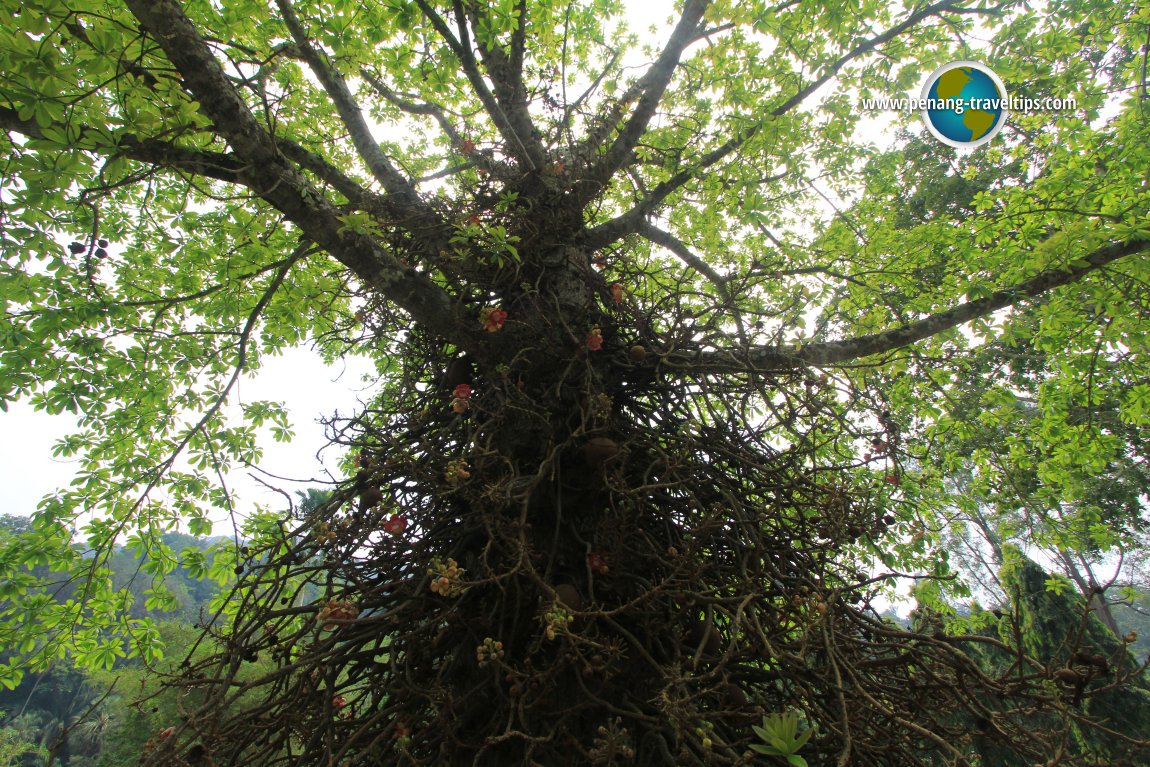 Cannonball Tree, Penang Botanic Gardens (2 August 2011)
What to see or do
The Penang Botanic Gardens is perhaps the best place to escape to a green surrounding. Despite being so close to a major city, the Penang Botanic Gardens offers a place where visitors can relax and at the same time admire the local and important plants. There are many walking paths and tracks in the garden, including forest paths that lead to Penang Hill. It is recommended to go with those who are familiar so as not to get lost in the jungle.Shots by featured photographers
I am also pleased to showcase the work of other photographers who has shot the Penang Botanic Gardens.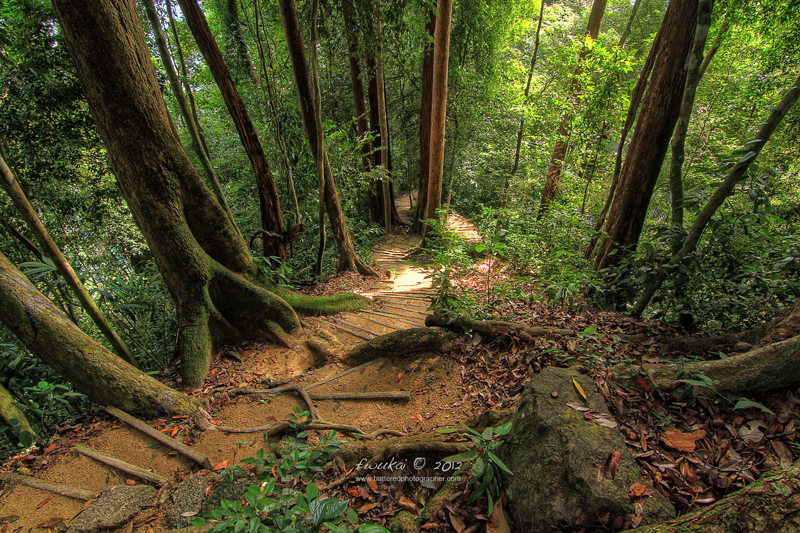 Lombard Trail, Penang Botanic Gardens
© FwuKai Quah using this photo
Author's Comment
2013While the Penang Botanic Gardens is successful in reinventing itself as a public park, it still has its work cut out in terms of educating the public about botanic any plant life. The extensive collection of plants started by the early colonial botanists is now in a sorry state. Most of the plants remain under lock and key, and a peer inside these plant houses show are some are in various states of neglect. Penang Travel Tips want to see the Penang Botanic Gardens play a more active role in educating the public and not remain just a recreational park.
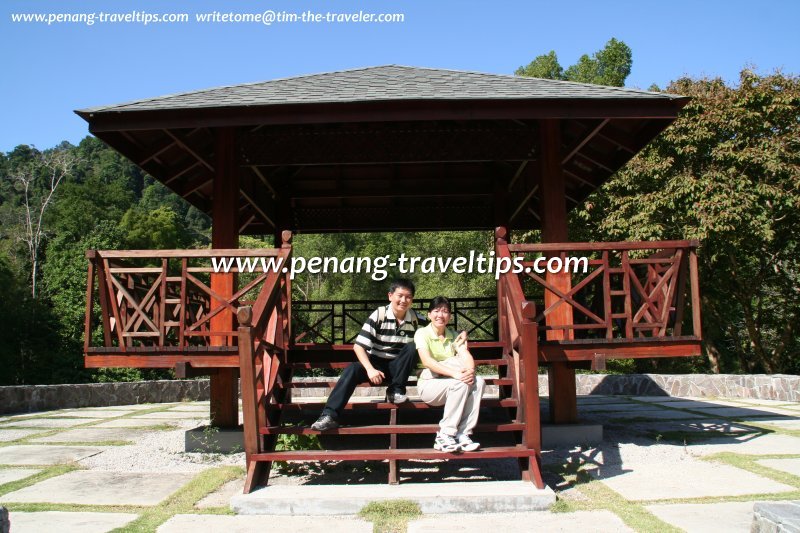 Tim & Chooi Yoke at the Penang Botanic Gardens (27 January 2008)
List of Penang Tourist Attractions
Buy, rent or sell properties in Penang
Do you have a property for sale or to rent out? Are you looking to buy or rent a property? Get in touch with me. WhatsApp me (Timothy Tye) at 012 429 9844, and I will assign one of my property agents to serve you. I will choose the agent for you, according to your property needs. So when you message me, provide me some details of what you need, whether to sell, to buy, to rent or to rent out, and what type of property, is it condo, apartment, house, shop, office or land.Adakah anda mempunyai hartanah untuk dijual atau disewakan? Adakah anda ingin membeli atau menyewa hartanah? Hubungi saya. WhatsApp saya (Timothy Tye) di 012 429 9844, dan saya akan menugaskan salah seorang ejen hartanah saya untuk berkhidmat kepada anda. Saya akan pilih ejen untuk anda, mengikut keperluan hartanah anda. Oleh itu, apabila anda menghantar mesej kepada saya, berikan saya beberapa butiran tentang apa yang anda perlukan, sama ada untuk menjual, untuk membeli, untuk disewakan atau untuk disewakan, dan jenis hartanah apakah itu kondo, pangsapuri, rumah, kedai, pejabat atau tanah.
您有待出售或出租的房产吗? 您想购买或租赁房产吗? 与我联系。 WhatsApp 我 (Timothy Tye) 012 429 9844,我将指派一名房地产经纪人为您服务。 我会根据您的房产需求,为您选择代理。 因此,当您给我发消息时,请向我提供一些您需要的详细信息,无论是出售、购买、出租还是出租,以及房产类型,是公寓、公寓、房屋、商店、办公室还是土地。
New Properties in Penang
Looking to buy property in Penang? Get the e-brochures right here without having to visit or contact individual developers.- Anggun Residences E-Brochure, Batu Kawan
- Aston Acacia E-Brochure, Bukit Mertajam
- Beacon Executive Suites E-Brochure, George Town
- Beverly Heights @ Bukit Gambir E-Brochure, Gelugor
- BM Highland E-Brochure, Bukit Mertajam
- Cypress Villa E-Brochure, Sungai Ara
- D'Zone Condominium E-Brochure, Teluk Kumbar
- Elements Garden E-Brochure, Butterworth
- Ferringhi Residence 2 E-Brochure, Batu Ferringhi
- GEM Residences E-Brochure, Prai
- Golden Triangle 2 E-Brochure, Sungai Ara/Relau
- Grace Residence E-Brochure, Jelutong
- Granito @ Permai E-Brochure, Tanjong Bungah
- Green City Residence E-Brochure, Jelutong
- Havana Beach Residences E-Brochure, Bayan Lepas
- Imperial Residences E-Brochure, Sungai Ara/Relau
- Imperial Grande E-Brochure, Sungai Ara/Relau
- Lucerne Residence E-Brochure, Bayan Lepas
- Mezzo @ The Light City E-Brochure, Gelugor
- Middleton E-Brochure, Gelugor
- Orchard Villa 3 E-Brochure, Simpang Ampat
- Primero Heights E-Brochure, Permatang Pauh
- Queens Waterfront Q2 E-Brochure, Bayan Lepas
- Royale Heights @ Tambun Royale City E-Brochure, Simpang Ampat
- Royale Infinity @ Tambun Royale City E-Brochure, Simpang Ampat
- Rubica @ Harbour Place E-Brochure, Butterworth
- Sensasi Commercial Suites E-Brochure, Batu Kawan
- Setia Sky Ville E-Brochure, Jelutong
- Setia Sky Vista E-Brochure, Sungai Ara/Relau
- Setia V Residence E-Brochure, Gurney Drive
- Sinaran Residence E-Brochure, Batu Kawan
- Sky @ TriPark E-Brochure, Bukit Mertajam
- Skyridge Garden E-Brochure, Tanjong Tokong
- Starhill Luxury Residences E-Brochure, Gelugor
- Straits Residences E-Brochure, Tanjong Tokong
- Taman Nuri Emas E-Brochure, Nibong Tebal
- The Light Collection IV E-Brochure, Gelugor
- The Loft @ Southbay E-Brochure, Batu Maung
- The Terraces Condominium E-Brochure, Bukit Jambul
- Trehaus Condo Villas E-Brochure, Bukit Jambul
- Triuni Residences E-Brochure, Batu Uban
- Urban Suites E-Brochure, Tanjong Tokong
- Valencia Residence E-Brochure, Bayan Lepas
- Vertu Resort E-Brochure, Batu Kawan
- Vivo Executive Apartment E-Brochure, Batu Kawan
- Viluxe E-Brochure, Batu Kawan
- Waterside Residence E-Brochure, Gelugor
Latest updates on Penang Travel Tips
Discover with Timothy YouTube Channel
PG Food Channel
Learn Penang Hokkien YouTube Channel
SojiMart Videos
Share your travels and/or ask a travel-related question
Join the Penang Travel Tips Facebook Group to share photos, tips and anything related to your travels, or ask travel-related questions.
 Map of Roads in Penang
Looking for information on Penang? Use this Map of Roads in Penang to zoom in on information about Penang, brought to you road by road. Discover with Timothy
Let me take you to explore and discover Penang through my series of walking tours on YouTube. You may use these videos as your virtual tour guide. At the beginning of each video, I provide the starting point coordinates which you may key into your GPS, Google Maps or Waze, to be navigated to where I start the walk, and use the video as your virtual tour guide.Disclaimer
Please use the information on this page as guidance only. The author endeavours to update the information on this page from time to time, but regrets any inaccuracies if there be any.Latest from Discover with Timothy: Gurney Bay - what to see and do there
About this website

Hello and thanks for reading this page. My name is Timothy and my hobby is in describing places so that I can share the information with the general public. My website has become the go to site for a lot of people including students, teachers, journalists, etc. whenever they seek information on places, particularly those in Malaysia and Singapore. I have been doing this since 5 January 2003, for over twenty years already. You can read about me at Discover Timothy. By now I have compiled information on thousands of places, mostly in Peninsular Malaysia and Singapore, and I continue to add more almost every day. My goal is to describe every street in every town in Malaysia and Singapore.
Robbie's Roadmap
- Episode 1: Robbie's Journey to Financial Freedom
- Episode 2: Lost in America
- Episode 3: The Value of Money
- Episode 4: The Mentor
- Episode 5: The Thing that Makes Money
- Episode 6: The walk with a Billionaire
- Episode 7: The Financial Freedom Awakening
- Episode 8: Meet Mr Washington
- Episode 9: The Pizzeria Incident
Copyright © 2003-2024 Timothy Tye. All Rights Reserved.