

Hock Teik Cheng Sin Temple 福德正神 (Poh Hock Seah)
 Go Back - Latest PENANG Sights/Streets/New Properties > Malaysia > World | Hokkien : Lessons : Dictionary | YouTube | Facebook | About Me : Contact Me
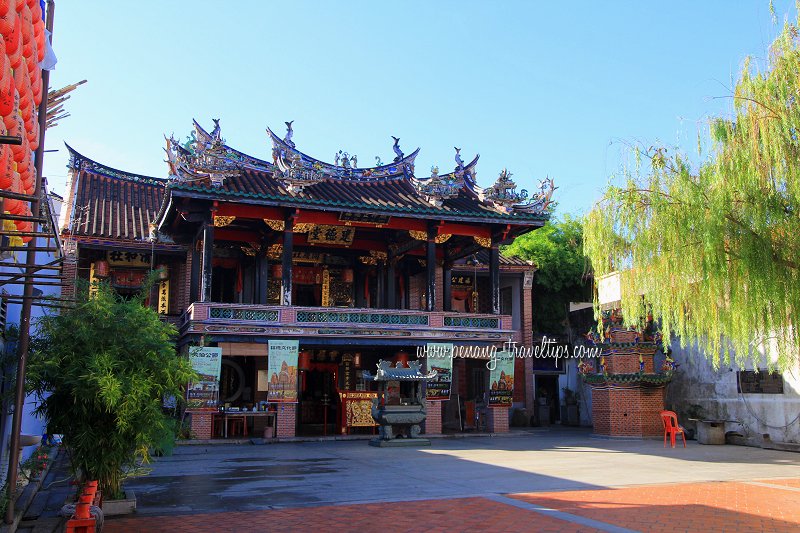 Hock Teik Cheng Sin Temple (30 June 2014)
The Hock Teik Cheng Sin Temple (GPS: 5.41514, 100.33713; Traditional Chinese: 福德正神廟; Simplified Chinese: 福德正神庙; Pinyin: Fú Dé Zhèng Shén Miào), also known as Poh Hock Seah, is a clan temple of the Hokkien people who trace their origin to Southern Fujian Province in China. It is Although registered with the Chinese Protectorate of Penang on 11 October 1892, the Hock Teik Cheng Sin can trace its roots back to 1844, with the founding of the Kean Teik Tong Hokkien association. It is one of the Hokkien institutions set up before the large influx of newcomers (collective called the Sinkheh) to Penang.
The Hock Teik Cheng Sin moved to its present site in 1850. It occupies a lot granted to its leader, Khoo Teau Pang. The temple and its surrounding buildings are believed to have been constructed between 1850 and 1867. It is most popularly known as the Hokkien Tua Pek Kong Temple, after its patron deity, Tua Pek Kong, the Taoist god of prosperity, who also goes by the name of Hock Teik Cheng Sin. The Tua Pek Kong in this case serves as the tutelary deity for the Hokkien people of George Town, a similar position played by the deity at the Cantonese Tua Pek Kong Temple.
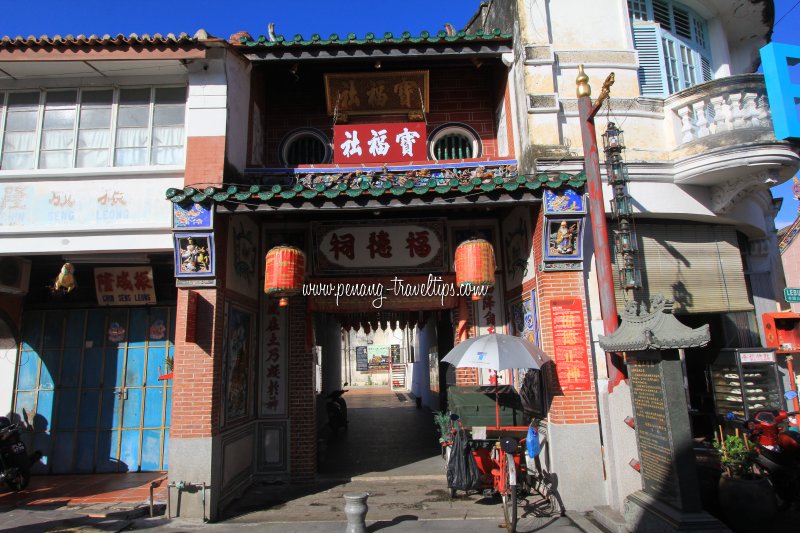 Entrance to Hock Teik Cheng Sin (30 June 2014)
The Kean Teik Tong was one of the two parties that was involved in the Penang Riots of 1867, together with the Ghee Hin Secret Society, an open warfare along the streets of Penang. During the riots, the Kean Teik Tong was allied with the Hai San, led by Kapitan China Chung Keng Kwee. As a result of the clashes, the British authorities subsequently banned all clan associations, giving them the dubious title of "secret societies".
Due to the ban, the Kean Teik Tong (also written Khian Teik Tong) found itself deregistered. It had to continue functioning other different guises, so various other societies were registered in its place, among them the Poh Hock Seah, the Hokkien Kongsi, Cheng Hoe Seah and Tong Kheng Seah. Each of these has its base at Hock Teik Cheng Sin. Of these, Poh Hock Seah is probably the most significant, which is why Hock Teik Cheng Sin became synonymous with Poh Hock Seah.
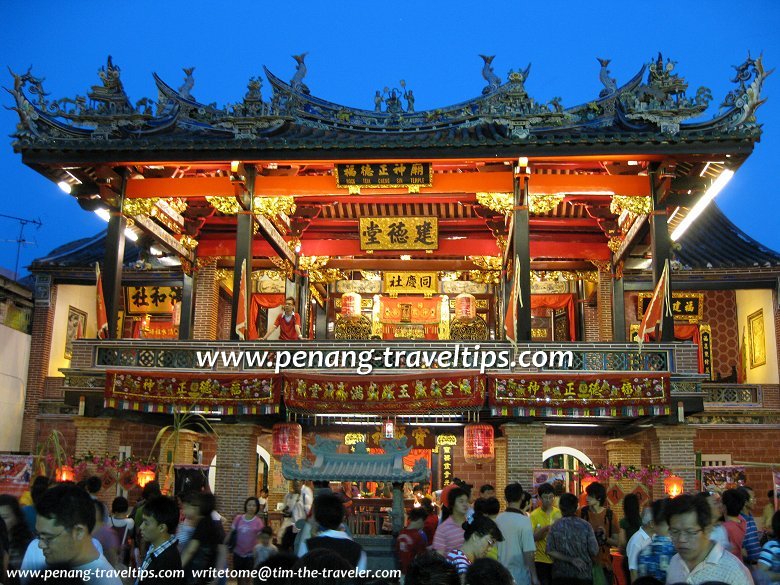 Hock Teik Cheng Sin during a Chinese New Year Open House (1 February 2009)
Poh Hock Seah occupies the entire ground floor of Hock Teik Cheng Sin. It was established in 1890, the year that the Kean Teik Tong was banned by the authorities and dissolved. It was set up to look after the interest of the Hokkien people in Penang, filling the void left by the Kean Teik Tong.
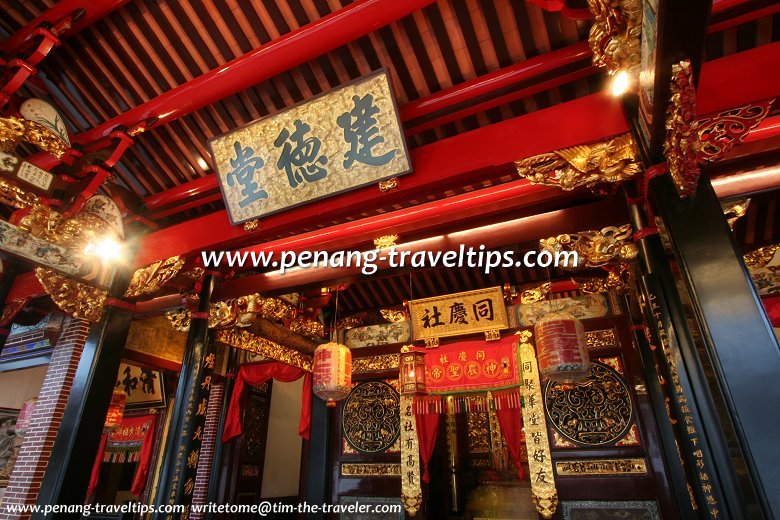 Upper Porch at Hock Teik Cheng Sin Temple (26 July 2008)
As the principal deity of Poh Hock Seah is the Tua Pek Kong, the Hock Teik Cheng Sin by extension became the Hokkien Tua Pek Kong Temple. As the god of prosperity and one in charged of bestowing blessings and safeguarding the Hokkien community, the Tua Pek Kong features prominently in all Hokkien settlements, where there would be a shrine large or small dedicated to it. And as Tua Pek Kong is also the patron deity of merchants, the Poh Hock Seah derives much influence and prestige by being the main site of its worship in George Town, and thus, in the whole Penang Island.
Chingay processions have their origin with the worship of the Tua Pek Kong. During Chingay processions, gaily decorated floats and giant flags are paraded along the streets of Penang originating from the Poh Hock Seah.
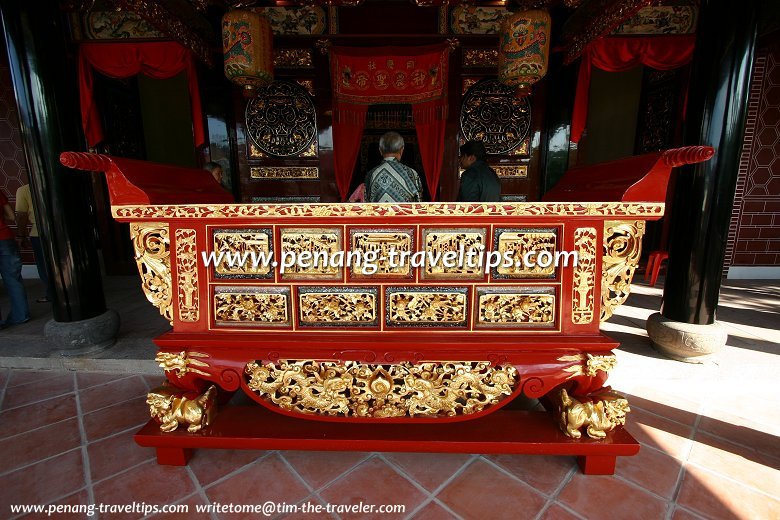 Hock Teik Cheng Sin offerings table (4 February 2006)
The Hokkien Kongsi occupies the upper left wing of the Hock Teik Cheng Sin Temple. It is formed by the board of trustees of the Big Five Hokkien clan associations of Penang, namely the Seh Tek Tong Cheah Kongsi, the Leong San Tong Khoo Kongsi, the Kew Leong Tong Lim Kongsi, the Eng Chuan Tong Tan Kongsi and the Sit Teik Tong Yeoh Kongsi.
The Hokkien Kongsi manages five Hokkien temples in Penang, namely the Hock Hin Keong (Snake Temple) in Sungai Kluang, the Seng Ong Beow at Bridge Street (Jalan CY Choy), Cheng Leong Keong (Tai Tay Yeah Temple) in Jelutong, Chooi Bee Keong Temple in Bagan Jermal and the Siew Thean Keong Temple in Dato Kramat.
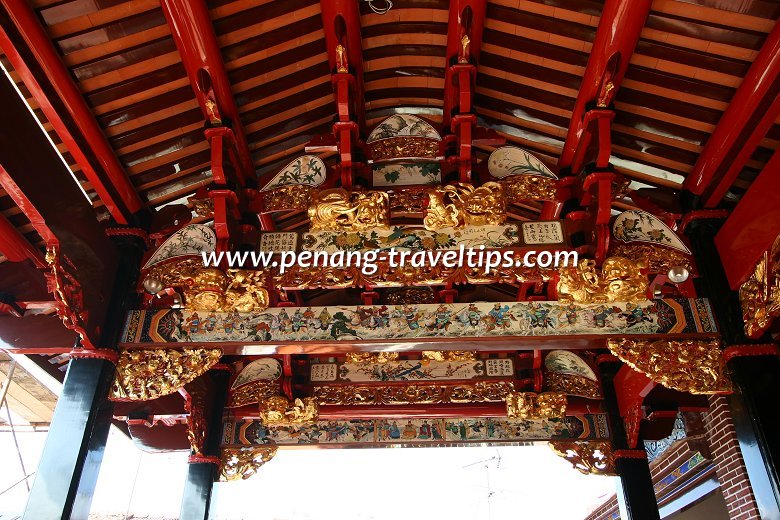 Intricate artwork on the ceiling beams reflect the artistry of the Chinese craftsmen (4 February 2006)
Cheng Hoe Seah is a Hokkien society occupying the upper right wing of the Hock Teik Cheng Sin Temple. Its patron deity is the Cheng Chooi Chor Soo. The Cheng Hoe Seah was founded as early as the 1840's. Its founding leader was Tan Cheng, believed to be one of the directors of the Batu Lanchang Hokkien Cemetery management committee back in 1841. The Cheng Hoe Seah moved into the Hock Teik Cheng Sin in 1849.
The Tong Kheng Seah is a Hokkien society that worships Sin Long Siang Tay, the patron saint of farmers and peasants. The feast day of Sin Long Siang Tay falls on the 14th day of the 2nd lunar month.
These legitimately registered societies were created when the British authorities outlawed the Khian Teik secret society in 1890. It simply transferred its assets to these societies. The Poh Hock Seah inherits the religious functions of the Khian Teik in running the Hokkien Tua Pek Kong temples in Armenian Street as well as at the Tanjong Tokong Tua Pek Kong Temple, where the annual flame watching ritual called Chneah Hoay is conducted.
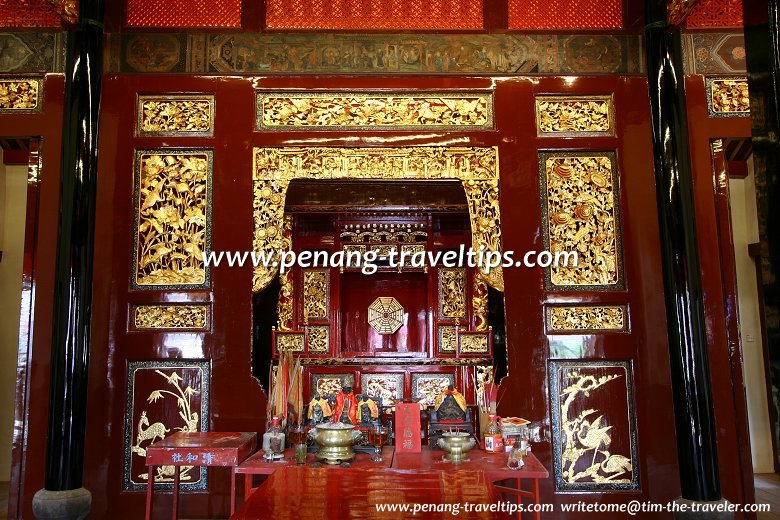 Altar to Sin Long Siang Tay, patron deity of the Tong Kheng Seah, in the central hall of the upper floor (4 February 2006)
When restoration work was corried out at the Hock Teik Cheng Sin, triangular fighting flags were uncovered. These were probably in use during the 1867 Penang Riot, when the Hokkien Tua Pek Kong and the Red Flag Society fought against the Cantonese Ghee Hin and the White Flag Society.
Warring factions were the state of affairs among the various Chinese clans in Penang during the late 19th Century. To provide for an easy escape, there is a secret passage at the side yard of the Hokkien Tua Pek Kong temple that leads to the grounds of its ally, the Leong San Tong Khoo Kongsi.
As this article is written (2006), the Hock Teik Cheng Sin is still in the midst of a RM1.3 million restoration project which includes the temple gateway, the stage, 10 neighbouring shops and of course, the temple itself.
Street Art
On the outer wall of the temple is the Poh Hock Seah Ink Painting.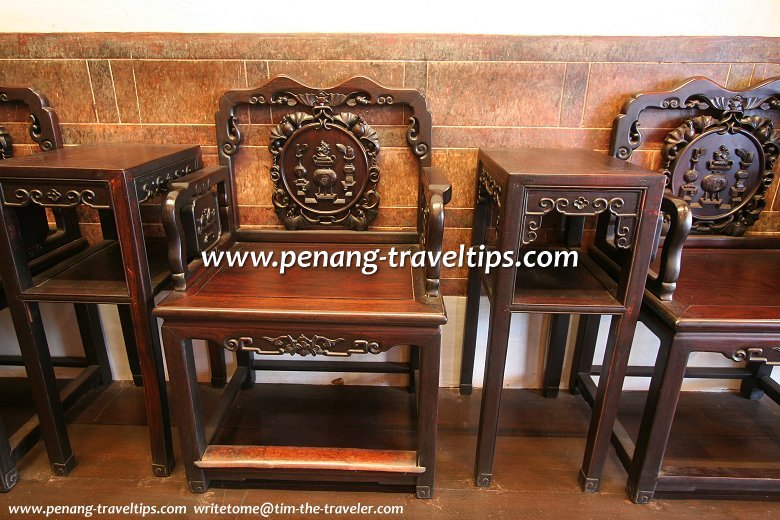 Rosewood furniture at Hock Teik Cheng Sin Temple (26 July 2008)
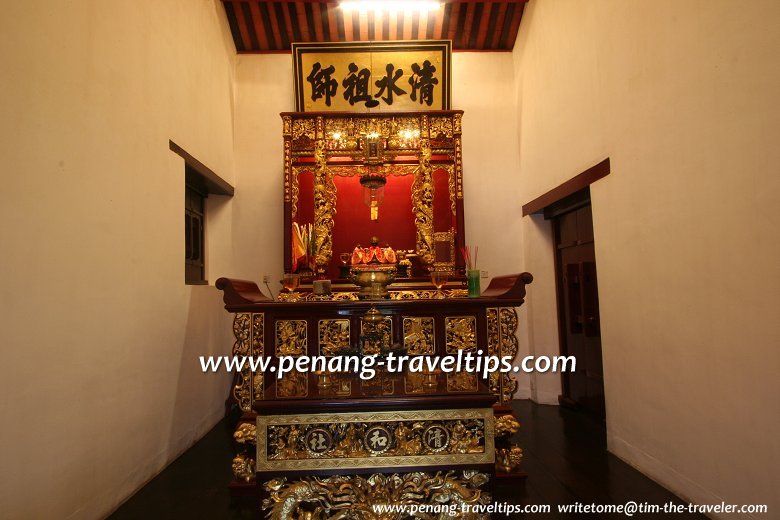 Altar to Cheng Chooi Chor Soo, patron deity of the Cheng Hoe Seah (26 July 2008)
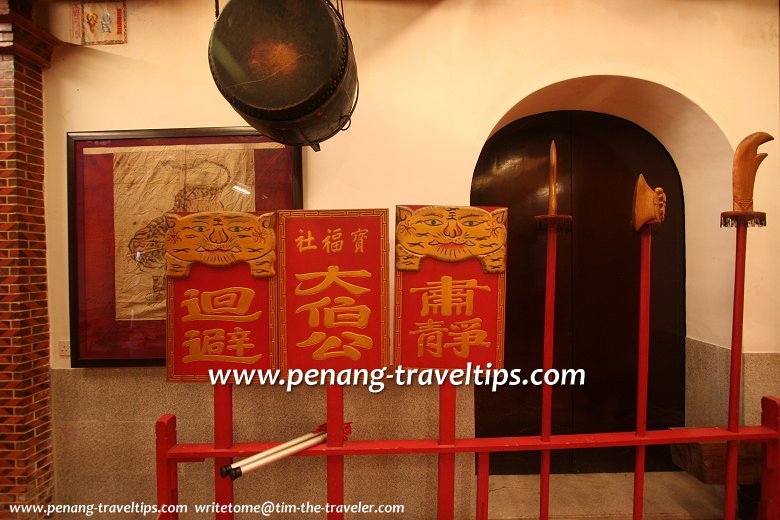 Processional banners and swords to be paraded on feast days (26 July 2008)
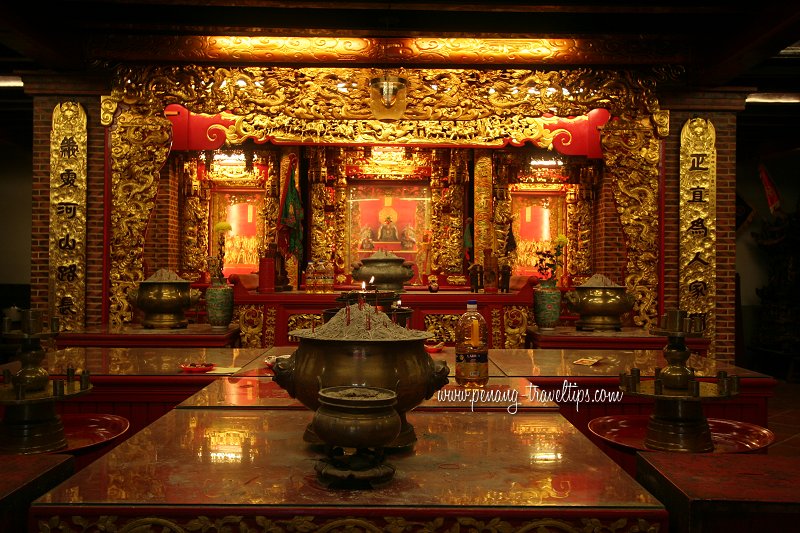 Tua Pek Kong Altar at Hock Teik Cheng Sin Temple (26 July 2008)
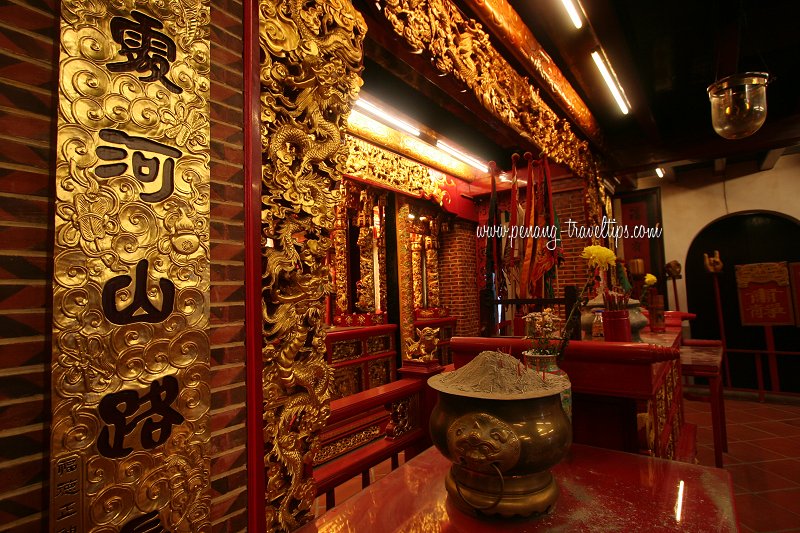 Tua Pek Kong Hall at Hock Teik Cheng Sin Temple (26 July 2008)
Contact
Hock Teik Cheng Sin Temple57, Lebuh Armenian,
10200 George Town, Penang
Phone: 013-431 7003
Getting there
The Hock Teik Cheng Sin Temple is located within its own compound at the corner between Armenian Street and Cannon Street. It is accessed via a short passageway. You can take Rapid Penang Bus 10, 12, 103, 301, 401 and CAT to Pitt Street (Jalan Masjid Kapitan Keling), then walk south till you reach the corner of Armenian Street and Cannon Street. The entrance to Hock Teik Cheng Sin Temple is on your left.Hock Teik Cheng Sin Temple is  on the map of Armenian Street
List of Tua Pek Kong Temples in Penang, Chinese Temples in Penang and Chinese Temples in Malaysia
 Buy, rent or sell properties in Penang
Do you have a property for sale or to rent out? Are you looking to buy or rent a property? Get in touch with me. WhatsApp me (Timothy Tye) at 012 429 9844, and I will assign one of my property agents to serve you. I will choose the agent for you, according to your property needs. So when you message me, provide me some details of what you need, whether to sell, to buy, to rent or to rent out, and what type of property, is it condo, apartment, house, shop, office or land.Adakah anda mempunyai hartanah untuk dijual atau disewakan? Adakah anda ingin membeli atau menyewa hartanah? Hubungi saya. WhatsApp saya (Timothy Tye) di 012 429 9844, dan saya akan menugaskan salah seorang ejen hartanah saya untuk berkhidmat kepada anda. Saya akan pilih ejen untuk anda, mengikut keperluan hartanah anda. Oleh itu, apabila anda menghantar mesej kepada saya, berikan saya beberapa butiran tentang apa yang anda perlukan, sama ada untuk menjual, untuk membeli, untuk disewakan atau untuk disewakan, dan jenis hartanah apakah itu kondo, pangsapuri, rumah, kedai, pejabat atau tanah.
您有待出售或出租的房产吗? 您想购买或租赁房产吗? 与我联系。 WhatsApp 我 (Timothy Tye) 012 429 9844,我将指派一名房地产经纪人为您服务。 我会根据您的房产需求,为您选择代理。 因此,当您给我发消息时,请向我提供一些您需要的详细信息,无论是出售、购买、出租还是出租,以及房产类型,是公寓、公寓、房屋、商店、办公室还是土地。
New Properties in Penang
Looking to buy property in Penang? Get the e-brochures right here without having to visit or contact individual developers.- Anggun Residences E-Brochure, Batu Kawan
- Aston Acacia E-Brochure, Bukit Mertajam
- Beacon Executive Suites E-Brochure, George Town
- Beverly Heights @ Bukit Gambir E-Brochure, Gelugor
- BM Highland E-Brochure, Bukit Mertajam
- Cypress Villa E-Brochure, Sungai Ara
- D'Zone Condominium E-Brochure, Teluk Kumbar
- Elements Garden E-Brochure, Butterworth
- Ferringhi Residence 2 E-Brochure, Batu Ferringhi
- GEM Residences E-Brochure, Prai
- Golden Triangle 2 E-Brochure, Sungai Ara/Relau
- Grace Residence E-Brochure, Jelutong
- Granito @ Permai E-Brochure, Tanjong Bungah
- Green City Residence E-Brochure, Jelutong
- Havana Beach Residences E-Brochure, Bayan Lepas
- Imperial Residences E-Brochure, Sungai Ara/Relau
- Imperial Grande E-Brochure, Sungai Ara/Relau
- Lucerne Residence E-Brochure, Bayan Lepas
- Mezzo @ The Light City E-Brochure, Gelugor
- Middleton E-Brochure, Gelugor
- Orchard Villa 3 E-Brochure, Simpang Ampat
- Primero Heights E-Brochure, Permatang Pauh
- Queens Waterfront Q2 E-Brochure, Bayan Lepas
- Royale Heights @ Tambun Royale City E-Brochure, Simpang Ampat
- Royale Infinity @ Tambun Royale City E-Brochure, Simpang Ampat
- Rubica @ Harbour Place E-Brochure, Butterworth
- Sensasi Commercial Suites E-Brochure, Batu Kawan
- Setia Sky Ville E-Brochure, Jelutong
- Setia Sky Vista E-Brochure, Sungai Ara/Relau
- Setia V Residence E-Brochure, Gurney Drive
- Sinaran Residence E-Brochure, Batu Kawan
- Sky @ TriPark E-Brochure, Bukit Mertajam
- Skyridge Garden E-Brochure, Tanjong Tokong
- Starhill Luxury Residences E-Brochure, Gelugor
- Straits Residences E-Brochure, Tanjong Tokong
- Taman Nuri Emas E-Brochure, Nibong Tebal
- The Light Collection IV E-Brochure, Gelugor
- The Loft @ Southbay E-Brochure, Batu Maung
- The Terraces Condominium E-Brochure, Bukit Jambul
- Trehaus Condo Villas E-Brochure, Bukit Jambul
- Triuni Residences E-Brochure, Batu Uban
- Urban Suites E-Brochure, Tanjong Tokong
- Valencia Residence E-Brochure, Bayan Lepas
- Vertu Resort E-Brochure, Batu Kawan
- Vivo Executive Apartment E-Brochure, Batu Kawan
- Viluxe E-Brochure, Batu Kawan
- Waterside Residence E-Brochure, Gelugor
Latest updates on Penang Travel Tips
Discover with Timothy YouTube Channel
PG Food Channel
Learn Penang Hokkien YouTube Channel
SojiMart Videos
Share your travels and/or ask a travel-related question
Join the Penang Travel Tips Facebook Group to share photos, tips and anything related to your travels, or ask travel-related questions.
 Map of Roads in Penang
Looking for information on Penang? Use this Map of Roads in Penang to zoom in on information about Penang, brought to you road by road. Discover with Timothy
Let me take you to explore and discover Penang through my series of walking tours on YouTube. You may use these videos as your virtual tour guide. At the beginning of each video, I provide the starting point coordinates which you may key into your GPS, Google Maps or Waze, to be navigated to where I start the walk, and use the video as your virtual tour guide.Disclaimer
Please use the information on this page as guidance only. The author endeavours to update the information on this page from time to time, but regrets any inaccuracies if there be any.Latest from Discover with Timothy: Gurney Bay - what to see and do there
About this website

Hello and thanks for reading this page. My name is Timothy and my hobby is in describing places so that I can share the information with the general public. My website has become the go to site for a lot of people including students, teachers, journalists, etc. whenever they seek information on places, particularly those in Malaysia and Singapore. I have been doing this since 5 January 2003, for over twenty years already. You can read about me at Discover Timothy. By now I have compiled information on thousands of places, mostly in Peninsular Malaysia and Singapore, and I continue to add more almost every day. My goal is to describe every street in every town in Malaysia and Singapore.
Robbie's Roadmap
- Episode 1: Robbie's Journey to Financial Freedom
- Episode 2: Lost in America
- Episode 3: The Value of Money
- Episode 4: The Mentor
- Episode 5: The Thing that Makes Money
- Episode 6: The walk with a Billionaire
- Episode 7: The Financial Freedom Awakening
- Episode 8: Meet Mr Washington
- Episode 9: The Pizzeria Incident
Copyright © 2003-2024 Timothy Tye. All Rights Reserved.